Turnitin AI Detector: How It Works and How Accurate It Is
The Turnitin AI detector is an AI writing checker built into Turnitin’s academic integrity workflow to flag portions of a submission that may have been
In this guide
Turnitin AI Detector: How It Works and How Accurate It Is
The Turnitin AI detector is an AI writing checker built into Turnitin’s academic integrity workflow to flag portions of a submission that may have been generated or altered by generative AI. It is not the same thing as Turnitin plagiarism detection: the similarity score compares submitted work with source material, while the AI writing score estimates how much qualifying prose may have come from an AI model. Turnitin itself describes the result as a signal for educators, not a standalone verdict, because the tool can misidentify human writing, AI writing, or AI-paraphrased text. (guides.turnitin.com)
What does Turnitin’s AI detector do?
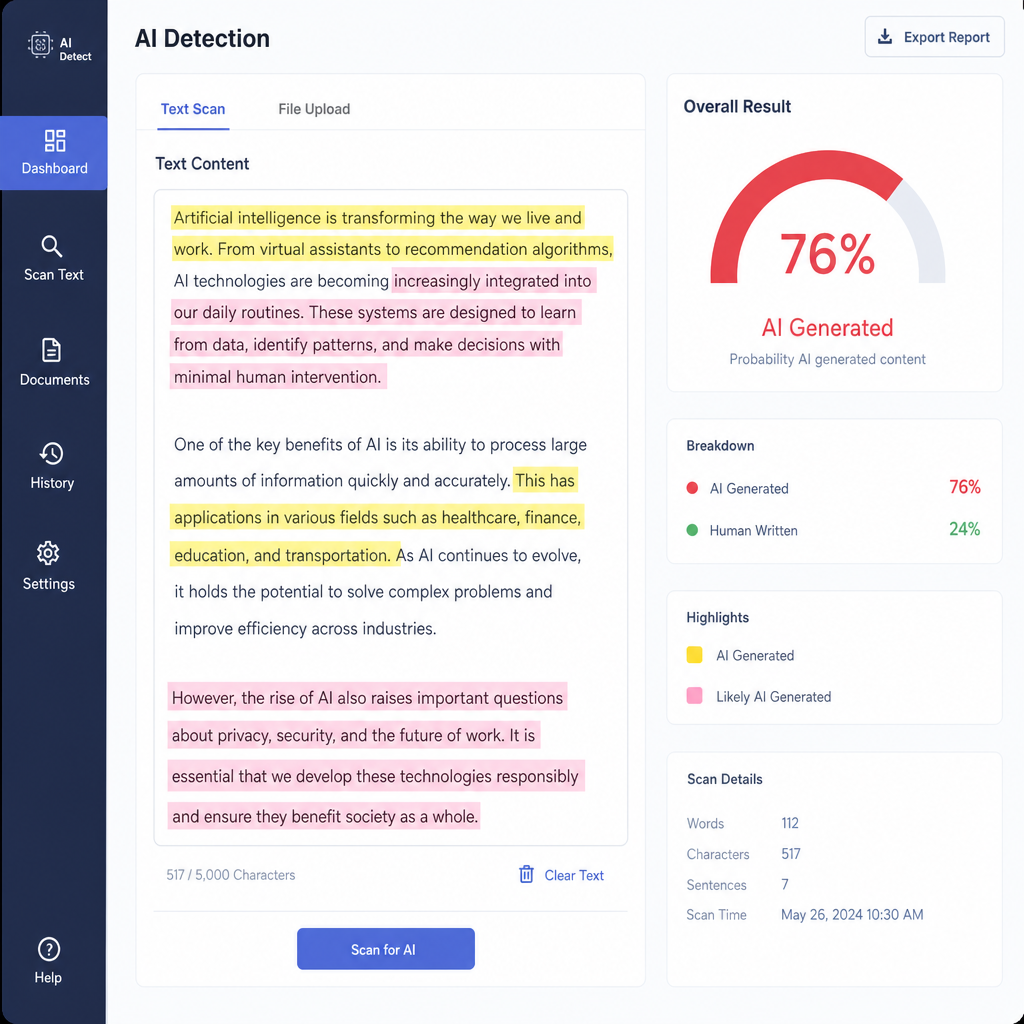
Turnitin’s AI detector reviews eligible submitted writing and produces an AI Writing Report showing the percentage of qualifying text that the model considers likely AI-generated or likely AI-generated and then modified by an AI paraphraser, word spinner, or bypasser tool. The report can also highlight passages in the submission so an instructor can see where the system found patterns associated with AI writing. (guides.turnitin.com)
That definition matters because many people use “AI plagiarism checker” as a shortcut, but AI detection and plagiarism detection are different tasks. Plagiarism checking asks whether wording or ideas overlap with existing sources. AI detection software asks whether the writing pattern resembles text produced by a large language model. A paper can have a low similarity score and a high AI score, or a high similarity score and no AI flag.
The defining characteristics are:
- It analyzes prose, not every kind of content. Turnitin says the model is intended for long-form prose such as essays, dissertations, and articles, not reliably for poetry, scripts, code, tables, bullet-heavy work, or annotated bibliographies. (guides.turnitin.com)
- It reports probability, not proof. The percentage is an estimate of qualifying text that may be AI-generated; it does not prove misconduct by itself. (guides.turnitin.com)
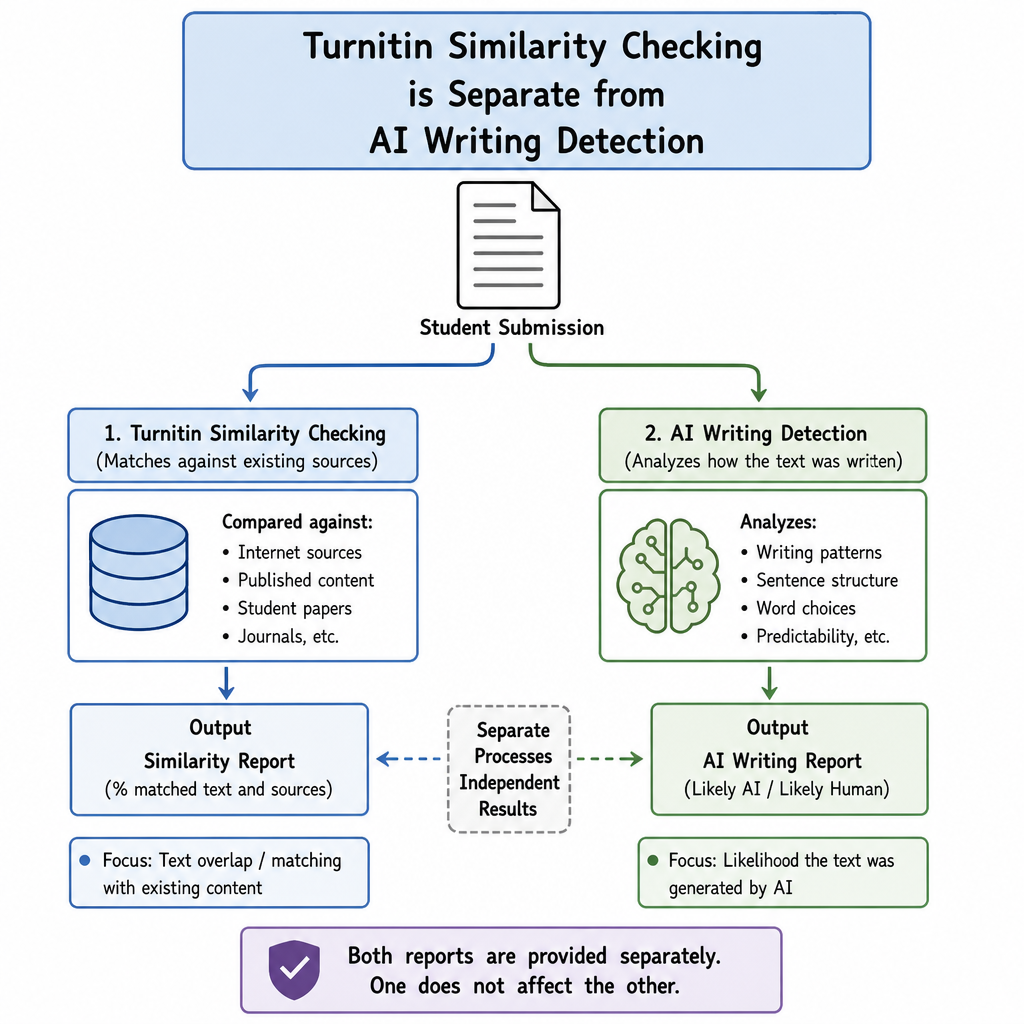
- It is separate from the Similarity Report. Turnitin states the AI percentage is independent of the similarity score, and AI highlights are not shown in the Similarity Report. (guides.turnitin.com)
- It depends on file and language eligibility. Turnitin lists requirements such as supported file types, word-count limits, and supported languages for the AI Writing Report. (guides.turnitin.com)
The score is separate from Turnitin plagiarism detection
Turnitin plagiarism detection, often shown through the Similarity Report, is built around text matching. It compares a submission against databases, publications, websites, and other submitted work to identify overlap. A similarity score does not automatically mean plagiarism; it can include properly quoted material, references, common phrases, or assignment prompts. The same caution applies to the AI detector Turnitin provides: the score is a review prompt, not a final judgment.
The AI Writing Report works differently because it does not need to find a copied source. Instead, the ai content detector looks for statistical and linguistic signals associated with AI-generated prose. That makes it useful for a different question: not “Where did this come from?” but “Does this writing look likely to have been generated or heavily transformed by AI?”
A simple comparison helps:
Tool or report | Main question it answers | What the result should trigger |
|---|---|---|
Similarity Report | Does this text match existing sources? | Source review, citation checking, context analysis |
AI Writing Report | Does qualifying prose appear likely AI-generated or AI-altered? | Instructor review, policy check, student conversation |
Human evaluation | Does the work meet the assignment’s expectations and authorship rules? | Final academic judgment based on evidence |
How does the AI detector Turnitin uses work?
Turnitin explains that a paper is divided into overlapping segments of a few hundred words so sentences can be evaluated in context. The model then scores sentences within those segments and averages segment-level results to estimate how much of the submission is likely AI-generated. (in.turnitin.com)
In practice, this means the tool is not simply scanning for obvious phrases such as “as an AI language model.” Modern AI detection software looks for broader patterns: consistency of sentence structure, predictability, phrasing, transitions, and other signals that may differ between human drafting and machine-generated prose. The exact model is proprietary, so users should avoid treating the score as a transparent calculation they can manually verify.
The workflow usually looks like this:
- A student submits a document through a Turnitin-enabled system. AI detection must be enabled for the account and assignment.
- Turnitin checks whether the file can be processed. The AI Writing Report has file, length, prose, and language requirements. (guides.turnitin.com)
- The model evaluates qualifying text. It focuses on prose sentences in long-form writing, excluding or underweighting formats it is not designed to assess reliably.
- The report displays an overall percentage. Instructors may see a score and highlighted text depending on the result range and interface. (guides.turnitin.com)
- The educator interprets the result with other evidence. Turnitin’s own guidance says the report should be used with human judgment and institutional policy. (guides.turnitin.com)
This is why an ai detector similar to Turnitin may produce a different result on the same text. Each tool has its own training data, thresholds, supported languages, and way of handling mixed human-and-AI writing.
How accurate is Turnitin’s AI detection?
Turnitin presents its AI writing detection as a high-confidence indicator, but not an infallible decision system. In Turnitin’s own explanation, the company says its AI checker has a 1% false positive rate for documents with over 20% likely AI-generated content, while also warning that results below 20% have a higher incidence of false positives and are less reliable. (in.turnitin.com)
That distinction is important. “Accurate” can mean several things: catching AI text when it exists, avoiding false accusations when writing is human, handling paraphrased AI content, and performing consistently across genres, languages, and student populations. A tool can perform well in controlled testing and still create difficult edge cases in real classrooms, especially when writing is short, heavily edited, translated, formulaic, or discipline-specific.
Turnitin’s interface reflects some of that uncertainty. For scores between 1% and 19%, Turnitin says an asterisk may appear and exact percentages or highlights may be withheld to reduce misinterpretation because lower scores are less reliable. (guides.turnitin.com)
So the most practical answer is: Turnitin’s AI detector can be useful as a screening tool, especially when a substantial portion of qualifying prose is flagged, but it should not be treated as courtroom-level proof. Vanderbilt University disabled Turnitin’s AI detector in 2023, citing concerns about false positives and the difficulty of using detector results responsibly at scale, which shows that institutional trust in these tools is not universal. (vanderbilt.edu)
Common reasons the result may be misunderstood
Misinterpretation often happens when users treat the AI percentage as if it were a direct measurement of misconduct. It is not. The number estimates likely AI-generated qualifying prose, not intent, policy violation, or whether the student was allowed to use AI.
Common misconceptions include:
- “A high AI score always means cheating.” Not necessarily. It means the writing deserves review under the assignment’s AI policy.
- “A 0% score proves no AI was used.” No detector can prove that; it only means the model did not identify qualifying text as likely AI-generated in that submission.
- “AI detection is the same as an ai plagiarism checker.” Plagiarism involves source use and attribution; AI detection involves authorship likelihood.
- “Every part of the file was checked equally.” Turnitin’s AI model focuses on qualifying long-form prose and may not reliably evaluate tables, code, bullets, or unconventional formats. (guides.turnitin.com)
- “Any AI use is automatically prohibited.” Some courses permit AI for brainstorming, outlining, grammar support, or revision, while others restrict it. The assignment policy matters.
For educators, the safest use is to pair the report with drafts, revision history, citations, writing conferences, and knowledge of the student’s prior work. For students, the safest approach is to follow the stated AI policy, keep drafts, document research, and be transparent when AI assistance is allowed.
Practical examples of appropriate use
An ai writing checker is most helpful when it supports a broader review process. It becomes risky when it replaces that process.
Useful applications include:
- Starting a conversation. An instructor may ask a student to explain sources, outline choices, or drafting steps when the report flags a large portion of text.
- Reviewing assessment design. Repeated AI flags across an assignment may suggest the prompt is too generic or too easy to outsource.
- Checking policy alignment. If AI use is allowed for editing but not drafting, highlighted sections may help identify where to ask follow-up questions.
- Supporting academic integrity training. Reports can help teachers explain the difference between acceptable assistance, unattributed AI generation, plagiarism, and poor citation practice.
- Triaging submissions. In large courses, AI detection software can help prioritize which papers need closer human review.
Poor applications include automatically failing a student based only on a percentage, using the tool on writing it is not designed to assess, or ignoring course policies that permit some AI support.
What to look for in any AI detector similar to Turnitin
If you are comparing an ai detector similar to Turnitin, look beyond a single accuracy claim. The best tool for academic use should make its limitations visible and fit your institution’s policy, privacy, and review standards.
A practical checklist includes:
- Does it separate AI detection from plagiarism or similarity checking?
- Does it explain what the score means in plain language?
- Does it identify unsupported formats, languages, or short submissions?
- Does it warn users about false positives and false negatives?
- Does it provide passage-level context rather than only a single number?
- Does it protect student data according to institutional requirements?
- Does it encourage human review before consequences are imposed?
The strongest process combines technology with transparent expectations. An ai detector Turnitin report can provide useful evidence, but academic integrity still depends on clear assignment rules, fair review, and careful human judgment.