10 Best QuillBot Alternatives in 2026
QuillBot is still a familiar choice for quick rewriting, but it is not the only option for people who need clearer sentences, stronger tone control, academic
In this guide
10 Best QuillBot Alternatives in 2026
QuillBot is still a familiar choice for quick rewriting, but it is not the only option for people who need clearer sentences, stronger tone control, academic support, or marketing-ready copy. The best QuillBot alternative depends on the job: a student may want a simple free paraphraser, while a content team may need brand voice, workflow controls, and deeper editing. Below are 10 practical paraphrasing tools, AI writing tools, and writing assistants worth testing in 2026.
How should you choose a QuillBot alternative?
Choose based on the kind of writing you revise most often, not just the number of rewrite buttons a tool offers. QuillBot’s own paraphraser uses modes such as Standard and Fluency on the free side, with Premium modes for more specific goals like Formal, Academic, Simple, Creative, Expand, Shorten, Humanizer, and Custom, so a good replacement should either match that quick-mode convenience or solve a problem QuillBot does not handle as well for your workflow. (help.quillbot.com)
Use this quick checklist before you commit:
- For school or research: prioritize citation discipline, academic tone, plagiarism awareness, and meaning preservation.
- For business emails: look for tone adjustment, grammar correction, and integrations with email or document apps.
- For long-form writing: choose tools with document-level editing, consistency checks, and readability feedback.
- For SEO or marketing: pick software with brand voice, content repurposing, and workflow features.
- For a quillbot alternative free option: check word limits, login requirements, available rewrite modes, and whether the free tool can handle paragraphs, not just single sentences.
1. Grammarly is the best all-around QuillBot alternative for everyday writing
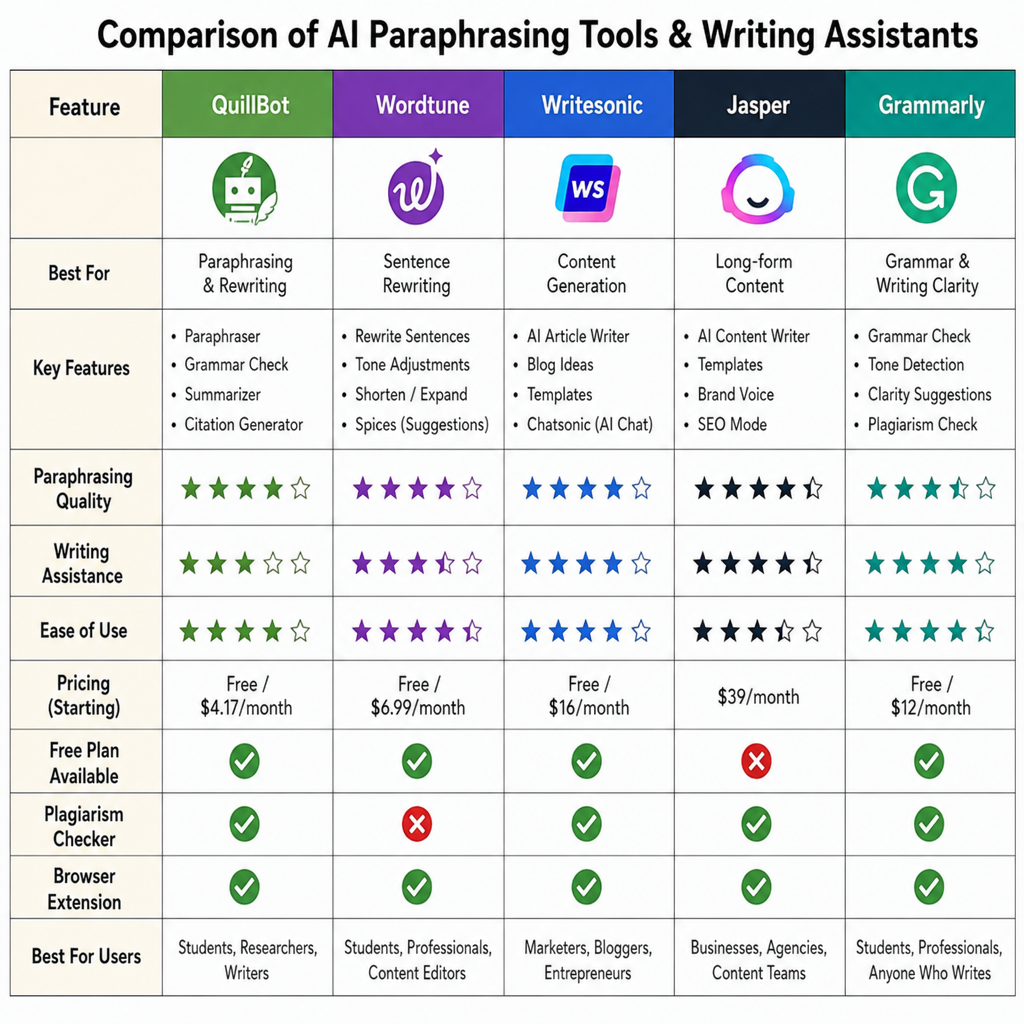
Grammarly is a strong first pick if you want paraphrasing plus grammar, tone, clarity, and rewrite suggestions inside everyday work. Its product materials describe AI features for full-paragraph rewrites, clearer phrasing, stronger structure, and communication support across common writing situations, which makes it less of a single-purpose paraphrase software tool and more of a broad writing assistant. (grammarly.com)
The biggest advantage is workflow. Instead of pasting every paragraph into a separate paraphrasing tool, you can use Grammarly while drafting emails, documents, messages, and web copy. That makes it especially useful for professionals who rewrite small pieces of text all day: a sales reply, a LinkedIn post, a project update, or a paragraph that sounds too stiff.
Grammarly is best for writers who want polish without thinking too much about modes. It can help tighten vague sentences, smooth awkward phrasing, and make a draft more direct. However, it may not be the best fit if your main goal is heavy academic paraphrasing or if you prefer a tool that shows many paraphrase variations side by side.
Best for: business writing, email, workplace communication, and everyday editing. Consider another tool if: you mainly need academic paraphrasing, bulk rewriting, or highly controlled content repurposing.
2. Wordtune is the best simple rewrite tool for sentence-level alternatives
Wordtune is ideal when you like QuillBot’s quick rewriting experience but want a cleaner focus on expression. Its help center describes a rewrite function that gives tone and suggestion options, and its editor is built around writing, rewriting, and summarizing in one place. (support.wordtune.com)
This is the kind of tool that works well when the sentence is basically correct but not quite right. Maybe it sounds blunt, too long, too casual, or slightly unnatural. Wordtune can help you look at a sentence from a few angles before you choose the version that still sounds like you.
For students, freelancers, and professionals, Wordtune’s strength is speed. It is not trying to be a full content operations platform or a deep manuscript editor. It is best when you want to improve flow, find a more natural synonym, shorten a thought, or rewrite a paragraph without turning the process into a major editing session.
Best for: quick rewrites, short paragraphs, social posts, captions, and emails. Consider another tool if: you need advanced SEO, long-form style reports, or team brand governance.
3. ProWritingAid is the best alternative for authors and long-form editors
ProWritingAid stands out because it combines rewriting with deeper writing analysis. Its official feature pages highlight grammar checking, 25+ writing reports, readability checks, repetition spotting, sentence-length analysis, pacing, dialogue feedback, and a Rephrase feature for tone, style, or length changes. (prowritingaid.com)
That makes it a better fit for book chapters, essays, scripts, and long articles than many lightweight paraphrasing tools. If a sentence is awkward, ProWritingAid can help rephrase it; if an entire chapter feels slow, repetitive, or uneven, its reports can help you see why. This difference matters because strong writing is not just a matter of swapping words.
ProWritingAid’s rephrase options also support different goals. Its help center lists types such as Standard, Fluency, Formal, Informal, Sensory, Shorten, and Lengthen, which gives writers more control over whether they want a sentence to sound more fluent, more concise, or more descriptive. (help.prowritingaid.com)
Best for: fiction writers, long-form bloggers, essay writers, and anyone who wants editing insight beyond paraphrasing. Consider another tool if: you only need fast one-click rewriting and do not want detailed reports.
4. LanguageTool is the best QuillBot alternative for multilingual writing support
LanguageTool is worth considering if your writing crosses languages or if you want a grammar-first tool with paraphrasing as part of the experience. Its help center describes it as an AI-powered writing assistant that identifies grammar, spelling, punctuation, and style issues, with a paraphrasing tool for rephrasing sentences for clarity or variety. (help.languagetool.org)
This makes it useful for people who write in English but also communicate in other languages, or for teams that need a clean editing layer before content goes to translation, localization, or review. It is not the flashiest AI writing tool on this list, but it can be a practical daily assistant for improving correctness and readability.
LanguageTool is a smart option when you want fewer distractions. Instead of prompting a large AI model to rewrite everything, you can focus on grammar, tone, and sentence-level clarity. That can be helpful for writers who want support but still want to keep tight control over their own wording.
Best for: multilingual communication, grammar checking, and clean sentence improvements. Consider another tool if: you need marketing workflows, long-form content generation, or advanced brand voice tools.
5. ChatGPT is the most flexible alternative for custom rewriting prompts
ChatGPT is not a dedicated paraphraser in the same way QuillBot is, but it is one of the most flexible rewriting options because you can define the exact outcome you want. OpenAI’s writing guidance notes that ChatGPT can help with drafting, rewriting, tightening, adjusting tone for a specific audience, and turning rough notes into clearer communication. (openai.com)
The main advantage is instruction depth. You can ask for a paragraph to be rewritten for a seventh-grade reading level, a warmer customer-support tone, a more concise executive summary, or a version that preserves every technical term. That makes ChatGPT useful when preset modes feel too limiting.
It also supports iterative editing. OpenAI’s help center describes writing blocks as editable draft areas where users can revise selected text or entire drafts, depending on device, plan, settings, and availability. (help.openai.com)
For best results, do not simply ask, “Paraphrase this.” Instead, give constraints: audience, tone, length, words to preserve, and what not to change. ChatGPT is powerful, but it needs clear direction if you want paraphrasing that keeps the original meaning intact.
Best for: custom rewrites, brainstorming alternatives, tone experiments, and transforming rough notes. Consider another tool if: you want preset modes, built-in plagiarism tools, or a simple free paraphrasing interface.
6. Google Gemini in Docs is the best choice for Google Workspace users
Gemini in Google Docs is a natural QuillBot alternative if your drafts already live in Google Workspace. Google’s documentation explains that users can select text in Docs and use Gemini to rephrase, shorten, elaborate, make text more formal or casual, bulletize, or summarize it. (support.google.com)
The benefit is convenience. You can work inside the same document instead of copying text into external paraphrasing tools. That reduces friction for teams editing proposals, lesson plans, internal documentation, campaign copy, or client-facing drafts.
Gemini is especially useful for reshaping format. If a paragraph needs to become bullets, a casual note needs to become more professional, or a long explanation needs to become shorter, it can handle those changes without breaking your document workflow. It is less ideal if you want a paraphraser that is independent from a specific productivity ecosystem.
Best for: Google Docs users, teams, document editing, and quick tone or format changes. Consider another tool if: you do not use Google Workspace or need a standalone paraphrase software tool.
7. Jasper is the best QuillBot alternative for brand-focused marketing teams
Jasper is built more for marketers than casual paraphrasing users. Its Brand Voice documentation says Jasper can analyze uploaded writing examples and create a personalized brand voice, while its content improvement materials position rewriting around adapting content for channels, audiences, and brand positioning. (help.jasper.ai)
That makes Jasper a better fit when the challenge is not just “make this paragraph different,” but “make this paragraph sound like our company.” For content teams, this distinction matters. A generic rewrite may be grammatically fine and still be unusable if it misses the brand’s tone, vocabulary, audience, or compliance expectations.
Use Jasper for repurposing campaigns, refreshing old landing page copy, adapting long-form content into shorter assets, and keeping multiple marketers aligned. It is likely more tool than a solo student or occasional writer needs, but for teams that publish often, its structure can save editing time.
Best for: marketing teams, content repurposing, brand voice, and campaign copy. Consider another tool if: you want a lightweight quillbot alternative free option for occasional use.
8. Copy.ai is the best alternative for GTM and content workflow automation
Copy.ai is another marketing-oriented option, but its center of gravity is go-to-market content and workflow. Its Brand Voice page explains that the platform can analyze existing on-brand content, generate content aligned with that voice, and create distinct brand voices for different audiences or ideal customer profiles. (copy.ai)
That makes Copy.ai useful when rewriting is part of a larger process. For example, a team might turn a webinar transcript into email copy, social posts, sales enablement snippets, and landing page sections. A basic paraphraser can reword a paragraph; Copy.ai is more useful when you need repeatable content production with human checkpoints.
Copy.ai’s own materials also describe a Paraphrase Tool for rewriting existing content for different audiences, channels, or tones. That is exactly where it can outperform simpler paraphrasing tools: not in one sentence, but in adapting the same message across a full marketing funnel. (copy.ai)
Best for: GTM teams, sales content, marketing workflows, and audience-specific rewriting. Consider another tool if: you need academic writing help or a minimalist sentence rewriter.
9. Rytr is the best lightweight alternative for budget-conscious content creators
Rytr is a practical choice for creators who want basic AI writing and rephrasing features without adopting a large enterprise platform. Its help center describes commands for expanding, shortening, and improving or rephrasing selected text, while its product page includes text editing features such as autocomplete, content expansion, grammar checking, and text improvement. (help.rytr.me)
Rytr works best for short-form content: captions, product blurbs, email drafts, outlines, and quick paragraphs. If QuillBot feels too narrow but Jasper or Copy.ai feels too large, Rytr sits in the middle as a general-purpose writing assistant.
The tradeoff is depth. Rytr can help you reshape and generate text, but it is not the same as a detailed manuscript editor, a full academic tool, or a sophisticated brand governance platform. Treat it as a fast drafting and rewording helper, then review the output carefully for accuracy and originality.
Best for: freelancers, creators, startup content, and short-form rewriting. Consider another tool if: you need deep editing reports, academic safeguards, or complex team workflows.
10. Scribbr is the best free academic-style paraphrasing option
Scribbr is a strong pick if you want a simple, academic-friendly paraphrasing tool with a low barrier to entry. Its paraphrasing page says users can reformulate sentences and paragraphs, paraphrase academic sources for essays, research papers, and theses, choose Standard or Fluency mode, and use the tool for free without registration. (scribbr.com)
This makes Scribbr especially appealing for students who need help understanding how to restate source material more clearly. It should not be used to disguise copied work or avoid proper citation. Instead, use it to compare wording options, then make sure the final sentence is accurate, properly cited, and genuinely integrated into your own argument.
Scribbr is not the most advanced platform on this list. It does not replace a full editor, and it may not offer the same broad marketing features as Jasper, Copy.ai, or ChatGPT. But if your priority is a quillbot alternative free experience for academic-style rewriting, it is one of the easiest tools to test.
Best for: students, academic paragraphs, source paraphrasing practice, and free rewriting. Consider another tool if: you need brand voice, SEO workflows, or long-document editing.
The best tool depends on your writing workflow
There is no single best QuillBot alternative for everyone. If you want everyday polish, start with Grammarly. If you want quick sentence variations, test Wordtune. If you write long-form work, ProWritingAid gives more editorial depth. If you work in Google Docs, Gemini may be the smoothest option. If you manage marketing content at scale, Jasper or Copy.ai will likely fit better than a basic paraphraser.
Here is the simplest way to narrow the list:
Need | Best starting point |
|---|---|
Everyday grammar and rewrites | Grammarly |
Fast sentence alternatives | Wordtune |
Fiction or long-form editing | ProWritingAid |
Multilingual support | LanguageTool |
Custom rewrite instructions | ChatGPT |
Google Docs rewriting | Gemini in Docs |
Brand voice marketing copy | Jasper |
GTM workflow rewriting | Copy.ai |
Lightweight content creation | Rytr |
Free academic paraphrasing | Scribbr |
Whichever tool you choose, use paraphrasing software as an editor, not a substitute for judgment. Always check that the rewrite preserves the original meaning, fits your audience, and follows the rules of your school, workplace, or publication. The best AI writing tools do not just make text different; they help you make it clearer, more useful, and more intentional.