Can Teachers Tell If You Use ChatGPT?
Teachers may be able to suspect or document ChatGPT use, but they usually cannot prove it from the writing alone.
In this guide
can teachers tell if you use chatgpt
Teachers may be able to suspect or document ChatGPT use, but they usually cannot prove it from the writing alone. ChatGPT usage detection is a mix of imperfect AI content detection tools, assignment-process evidence, school account logs, writing comparisons, and direct conversations about how the work was produced. OpenAI tells educators that AI detectors are not reliable enough for high-stakes judgments and that ChatGPT itself cannot reliably identify whether it wrote a passage. (help.openai.com)

Can teachers tell if you use ChatGPT?
Sometimes, but not with certainty in every case. A teacher might notice sudden changes in voice, unusually polished structure, invented citations, missing drafts, or answers that do not match what a student has shown in class. They may also use school-approved tools for chatgpt detection, plagiarism review, version history, browser restrictions, or learning-platform activity logs.
The important distinction is between suspicion, evidence, and proof. A detector score is not the same as proof. A teacher seeing that a student pasted a large finished essay into a document minutes before submission may be stronger evidence than an AI score. A conversation in which a student cannot explain their own argument may also matter more than chatbot analysis alone.
In practice, schools often combine signals. They may look at writing style, assignment history, drafts, source quality, metadata, and whether AI use was allowed under the class policy. If the policy says “AI may be used for brainstorming if cited,” then the question is not simply whether ChatGPT was used; it is whether the student used it in the permitted way.
What ChatGPT usage detection means
ChatGPT usage detection is the attempt to identify whether a student used ChatGPT or a similar AI chatbot to create, revise, summarize, translate, outline, or polish academic work. It is not one single technology. It is a set of methods that can include automated AI content detection, human review, ai usage tracking in managed systems, and comparison with a student’s known writing.
The term can be confusing because “used ChatGPT” can mean many different things. A student might ask for an outline, check grammar, generate a first draft, translate notes, brainstorm counterarguments, or produce an entire paper. Each use leaves different traces, and not all uses violate academic rules.
Defining characteristics of ChatGPT usage detection include:
- Probability, not certainty: Most AI detectors estimate likelihood rather than prove authorship.
- Context dependence: The same text may be acceptable in one course and prohibited in another.
- Multiple evidence types: Teachers may consider drafts, document history, citations, oral explanations, and writing patterns.
- Risk of false results: Human writing can be flagged as AI-written, especially concise, formulaic, or second-language writing.
- Policy relevance: Detection only matters academically when it is connected to the assignment’s rules.
OpenAI’s guidance to educators emphasizes that detectors can make mistakes and may incorrectly label human-written text as AI-generated. It also notes that small edits can make AI-generated writing harder to detect, which is one reason detection alone is a weak foundation for serious academic consequences. (help.openai.com)
How do teachers detect ChatGPT use?
Teachers detect possible ChatGPT use by looking for patterns in both the submitted work and the process behind it. The writing itself may raise questions, but process evidence is often more useful. A polished final answer with no outline, no draft, no notes, and no revision history may invite more scrutiny than a paper that shows visible development over time.
Common signals include:
- A sudden style shift If a student usually writes in short, informal sentences and suddenly submits a highly structured essay with advanced vocabulary, a teacher may ask questions. This does not prove AI use, but it can trigger review.
- Generic or overbalanced writing AI-generated text can sound smooth while avoiding specific class details, personal reasoning, or direct engagement with assigned materials. Teachers may notice when an essay says a lot without making a precise argument.
- Weak source behavior Chatbots may invent sources, misstate readings, or cite real authors for claims they did not make. If the assignment requires evidence, teachers may check whether quoted or paraphrased material actually exists.
- Document and platform history In some school environments, teachers can review version history, timestamps, LMS submissions, browser restrictions, or managed-device activity. This is ai usage tracking rather than text analysis, and it depends on the school’s tools and policies.
- Follow-up questioning A teacher may ask a student to explain a claim, define a term, discuss a source, or reproduce part of the reasoning. If the student cannot explain the work, the concern becomes about authorship and learning, not just chatbot usage metrics.
None of these signals is perfect. A strong student may improve quickly. A nervous student may struggle to explain their own work. A multilingual student may use grammar support appropriately. That is why fair review should focus on evidence, policy, and conversation rather than assumptions.
AI detectors have serious limits
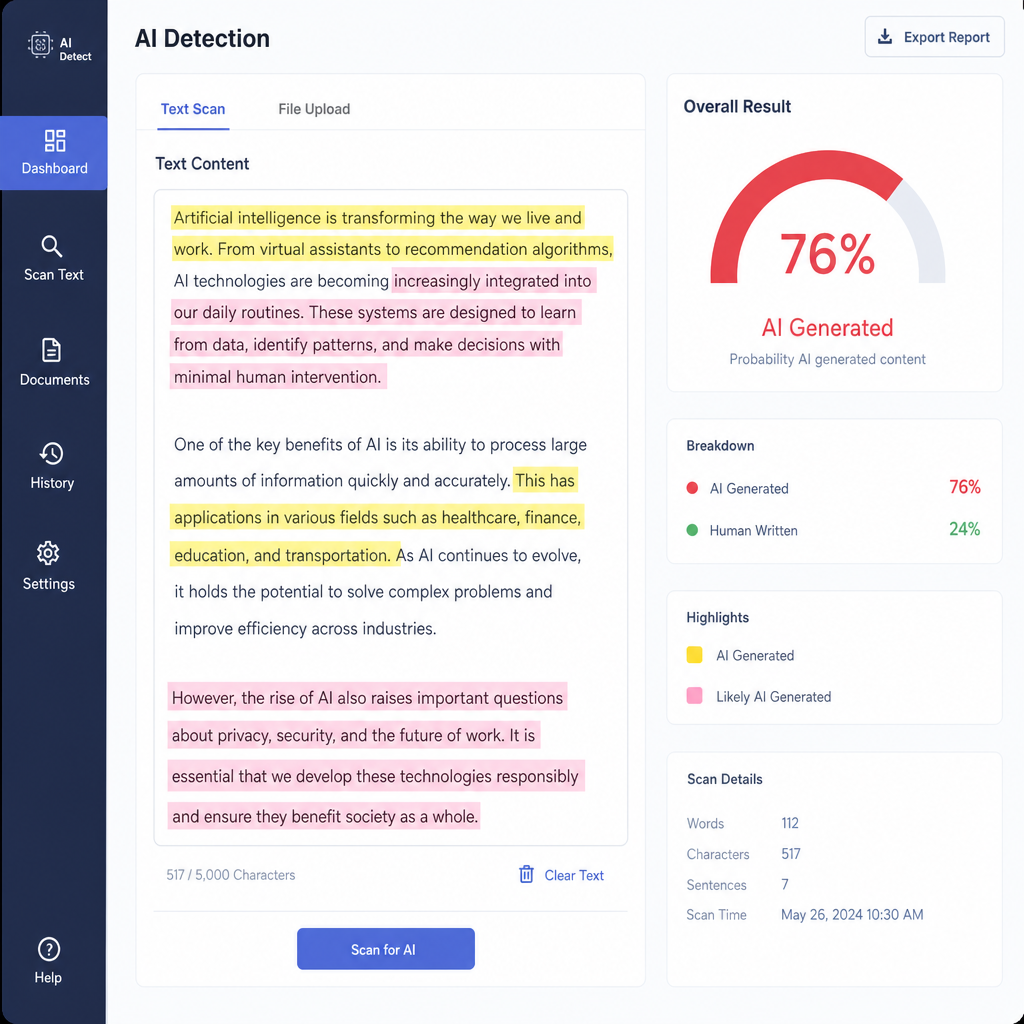
AI content detection tools usually analyze patterns in language and estimate whether text resembles machine-generated writing. They may consider predictability, sentence structure, vocabulary patterns, or similarities to known AI output. The problem is that good human writing and edited AI writing can overlap.
OpenAI has stated that, in its experience, AI detectors have not been reliable enough for decisions that could have lasting consequences for students. It also says ChatGPT has no dependable knowledge of whether it generated a particular text, so asking the chatbot “Did you write this?” is not a valid method of chatgpt identification. (help.openai.com)
This matters because false accusations can harm students. A detector might flag a human-written essay because it is formal, concise, repetitive, or written by someone using English as an additional language. On the other side, a student can heavily edit AI-generated text, making it less detectable. The result is an uncomfortable truth: AI detection can be a clue, but it should not be treated as a final verdict.
A more responsible approach is to treat detector output as one piece of information. If a teacher sees a high AI score, they should still look at the assignment instructions, drafts, citations, classroom performance, and the student’s explanation. For students, the practical lesson is simple: keep your process visible.
What counts as using ChatGPT for schoolwork?
Using ChatGPT means relying on the tool at any stage of the assignment, even if the final words are not copied directly from the chatbot. Whether that is allowed depends on the course policy. Some teachers ban it completely; others allow it for brainstorming, feedback, outlining, coding help, or grammar support when disclosed.
Here are practical examples of different levels of use:
- Low-risk support when allowed: Asking ChatGPT to explain a difficult concept, suggest study questions, or help you understand feedback.
- Process help that may need disclosure: Using ChatGPT to brainstorm topics, organize an outline, or identify possible counterarguments.
- Writing assistance that often requires citation: Asking ChatGPT to rewrite paragraphs, improve tone, summarize sources, or generate examples.
- High-risk or prohibited use: Submitting AI-generated text as your own work, inventing citations, or using ChatGPT during a closed-book test.
- Ambiguous use: Running your draft through a chatbot for grammar or clarity when the teacher has not said whether that is allowed.
The safest standard is not “Will I get caught?” but “Would I be comfortable explaining exactly how I used it?” If the answer is no, the use probably needs clarification before submission.
School accounts, privacy, and AI usage tracking
Teachers do not automatically see a student’s personal ChatGPT history just because the student used ChatGPT. However, privacy and visibility can change when a student uses a school-managed account, school device, school network, classroom platform, or institutional workspace. OpenAI’s help materials note that organization administrators may be able to access, manage, retain, or control data in managed ChatGPT accounts, depending on workspace settings. (help.openai.com)
ChatGPT also has data controls that let users manage settings such as model training, chat history, shared links, and data export, though available controls depend on account status, plan, and workspace settings. Turning off model improvement affects whether new conversations are used to improve OpenAI models; it does not necessarily make school-managed activity invisible to an organization’s administrators. (help.openai.com)
For students, the key point is practical: do not assume that every tool, browser, or account is private. If you are using a school account or device, follow the school’s technology policy. If you are using a personal account for permitted study help, still follow the assignment’s academic honesty rules.
Honest AI use is easier to defend
The best way to avoid problems is to make your learning process clear. Teachers are usually less concerned that a student used a tool and more concerned that the student misrepresented authorship, skipped the learning task, or submitted work they do not understand.
A simple checklist can help:
- Read the assignment’s AI policy before starting.
- Ask the teacher if the policy is unclear.
- Keep outlines, notes, drafts, and source records.
- Save prompts and responses if AI use is allowed or must be cited.
- Do not submit AI-generated claims without checking them.
- Make sure you can explain every argument, source, and conclusion.
- Disclose AI help when required, using the format your teacher requests.
Used transparently, ChatGPT can support studying, brainstorming, and revision. Used secretly in place of your own work, it creates academic risk because teachers may notice inconsistencies and because you may not be able to explain what you submitted.
The bottom line
Teachers can sometimes tell if you use ChatGPT, especially when the final work does not match your process, voice, sources, or classroom understanding. But chatgpt detection is not a perfect science, and AI content detection tools should not be treated as unquestionable proof.
The more useful question is whether your use follows the rules of the assignment. If ChatGPT is allowed, document how you used it and stay responsible for the final work. If it is not allowed, do not use it for that task. Clear process, honest disclosure, and real understanding are still the strongest protection against problems.