Are AI Detectors Accurate? What the Research Says
AI detectors can be useful warning signals, but they are not reliable enough to prove authorship on their own.
In this guide
Are AI Detectors Accurate? What the Research Says
AI detectors can be useful warning signals, but they are not reliable enough to prove authorship on their own. The research shows a mixed picture: some AI detection tools perform well on clean, controlled samples, yet their accuracy drops when writing is edited, paraphrased, translated, short, highly formal, or produced by non-native English writers. If you are asking whether to trust an AI score, the safest answer is to treat it as one piece of context, not a verdict.
Are AI detectors accurate?
AI detectors are sometimes accurate, especially when they evaluate longer passages of unedited AI-generated text that resemble the data they were trained to detect. They become much less dependable in real-world situations where a document may include human drafting, AI-assisted editing, grammar correction, translation, citations, templates, or multiple revisions. That is why the practical answer to “are ai detectors accurate” is: accurate enough to raise a question in some cases, but not accurate enough to settle the question without additional evidence.
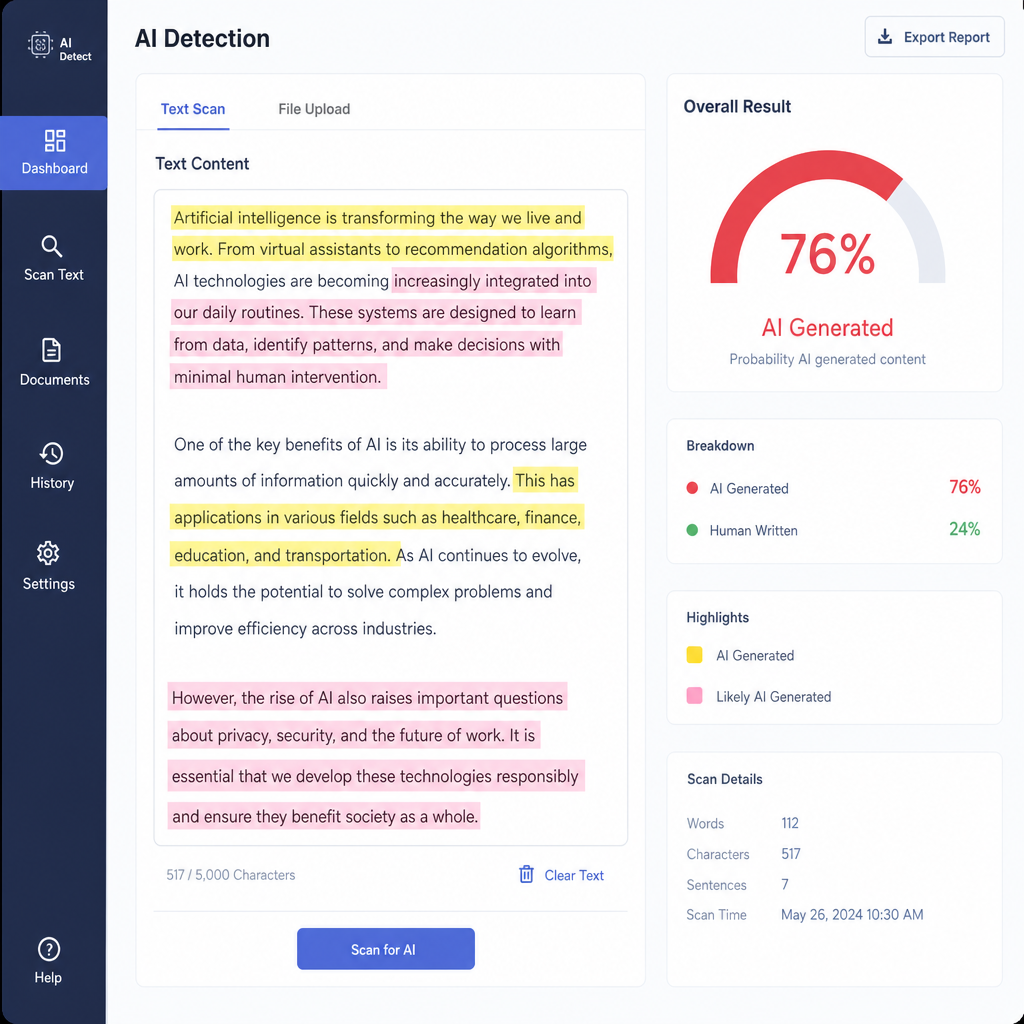
The key issue is that AI detection is probabilistic. A detector does not usually “know” who wrote a passage. It estimates whether the text resembles patterns associated with AI-generated writing, then converts that estimate into a score, label, or highlighted passage. GPTZero’s own support documentation describes current AI detection as “probabilistic and predictive,” while Turnitin’s guidance says its percentage reflects qualifying text the model determines could be AI-generated or AI-generated and then modified with paraphrasing tools. (support.gptzero.me)
That distinction matters. A plagiarism checker can often point to matching text in a source. An AI detector is making a statistical judgment about style, predictability, and patterns. The result may be helpful, but it is not the same as proof.
What the research says about AI detector accuracy
The research does not support a simple “yes” or “no.” Some studies find strong performance from specific tools under specific test conditions. Other studies find high error rates, inconsistent tool behavior, and serious fairness concerns. The accuracy of ai detection depends heavily on the dataset, writing genre, text length, model used to generate the text, detector threshold, and whether the writing has been revised.
A 2023 comparison of 16 AI text detectors found that Copyleaks, Turnitin, and Originality.ai performed strongly across the human-written, GPT-3.5-generated, and GPT-4-generated documents used in that study. The same paper still evaluated tools by multiple error types, including false positives, false negatives, and uncertain outputs, which is important because a high overall score can hide serious weaknesses in particular situations. (doi.org)
Other research has been more cautious. A higher-education study on GenAI detection tools found that already limited detector accuracy fell sharply when content was manipulated with adversarial techniques, concluding that these tools should not currently be recommended for deciding whether academic-integrity violations occurred. That finding is especially relevant because real student and professional writing is rarely a clean “100% human” or “100% AI” sample. (arxiv.org)
OpenAI’s own experience also illustrates the difficulty. Its AI Text Classifier was made unavailable in July 2023 because of a low rate of accuracy, even though OpenAI continued to research improved approaches. That does not mean every detector is useless, but it does show that even a leading AI lab treated text detection as an unsolved problem rather than a settled technology. (openai.com)
Why results vary so much from one tool to another
Two people can paste the same essay into several AI detection tools and receive completely different results. One tool may say a passage is mostly human, another may flag half of it, and another may return a high AI probability. That disagreement is not surprising because different detectors use different training data, scoring thresholds, model architectures, and definitions of what counts as suspicious.
Several factors can change ai detector accuracy:
- Text length: Short samples give detectors less evidence. Many tools perform better on longer passages because patterns become more visible across paragraphs.
- Writing genre: Formal essays, abstracts, grant language, marketing copy, product descriptions, and résumé bullets often use predictable phrasing, which can resemble AI output.
- Editing history: Human writing that has been heavily polished by grammar tools may look smoother and more uniform than a rough draft.
- Model generation: A detector trained on older model outputs may struggle with newer systems or different writing styles.
- Mixed authorship: A document that combines human ideas with AI brainstorming, outlining, rewriting, or proofreading is harder to classify than a fully generated sample.
- Threshold settings: A strict detector may catch more AI text but create more false positives. A conservative detector may protect human writers but miss more AI-generated content.
- Language background: Non-native English writing can be misread when detectors treat linguistic regularity as a machine-like signal.
This is why the question “how accurate are ai detectors” should always be followed by “accurate on what kind of text, under what conditions, and for what decision?” A detector that performs well on long, unedited AI essays may perform poorly on a short, polished paragraph written by a multilingual student.
The false-positive problem is not a minor detail
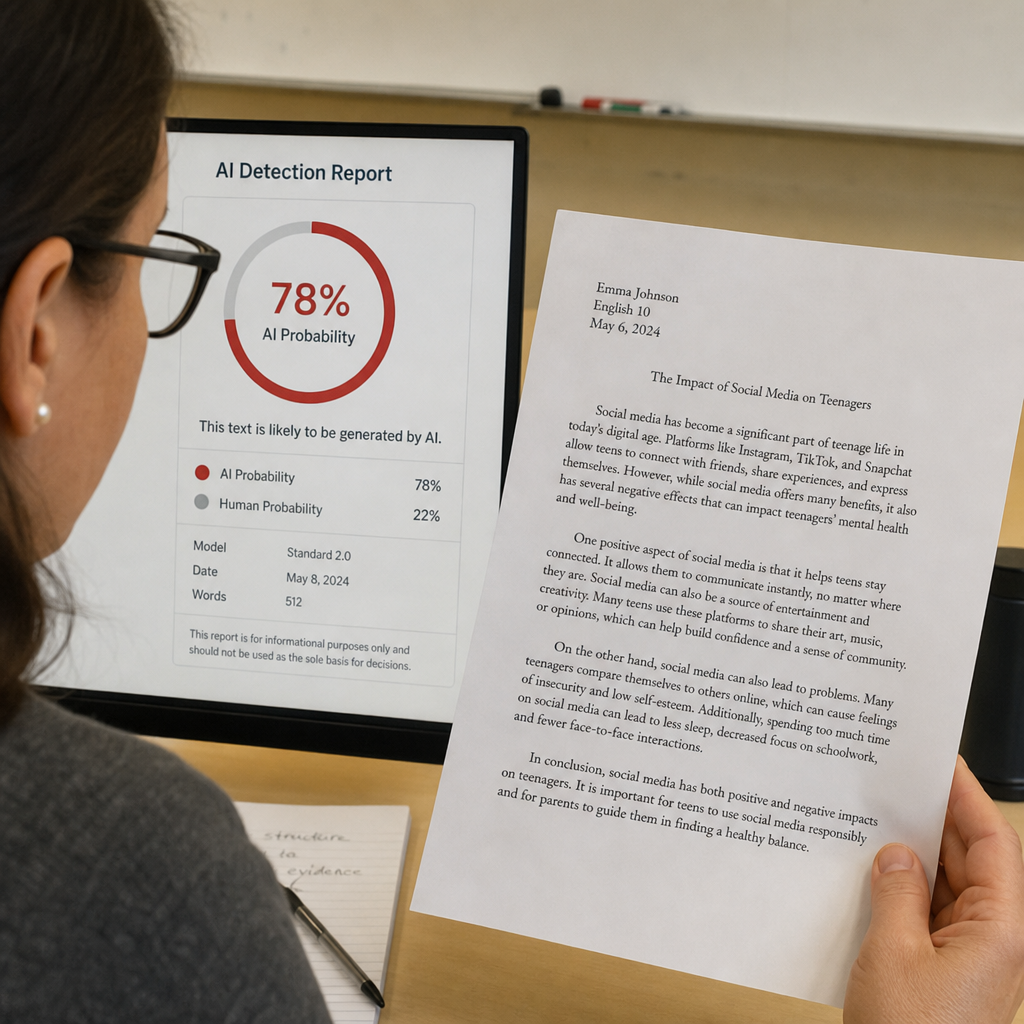
False positives are the most serious practical risk. A false positive happens when human-written text is incorrectly flagged as AI-generated. In low-stakes settings, that may be annoying. In high-stakes settings such as school discipline, hiring, publishing, or immigration-related writing, it can be deeply unfair.
A widely cited Stanford-affiliated study published in Patterns tested seven GPT detectors on essays by non-native English writers and U.S. eighth-grade students. The study found that more than half of the TOEFL essays by non-native English writers were misclassified as AI-generated, while the detectors performed much better on the native-speaker student essays. It also reported that at least one detector flagged 97.8% of the TOEFL essays as AI-generated, even though those essays were human-written. (doi.org)
That finding helps explain why AI detector accuracy cannot be judged only by an average number. If a tool performs well for one group but unfairly flags another, it is not reliable enough for serious decisions without safeguards. Research and policy discussions continue to emphasize that multilingual writers, highly structured academic writers, and people using standard templates may face elevated risk from automated scoring. (link.springer.com)
False negatives matter too. A false negative happens when AI-generated text is labeled human. When users paraphrase AI output, translate it, run it through “humanizer” tools, or combine it with original writing, detection can become harder. In other words, the same system can wrongly accuse an honest writer while missing a dishonest one.
How accurate are AI detectors in everyday use?
In everyday use, AI detectors are less accurate than many marketing claims suggest because everyday writing is messy. People outline with AI, draft by hand, use spellcheckers, accept grammar suggestions, paste in boilerplate, revise with peers, translate ideas, and edit over multiple sessions. Those normal behaviors blur the boundary that detectors are trying to classify.
This is why vendor accuracy claims need careful reading. A company may report high accuracy on its own benchmark, and that benchmark may be real, but it may not match your document type, your audience, your language variety, or your policy question. Copyleaks, GPTZero, and Turnitin all publish guidance or claims about performance, but each tool frames results through its own methodology and product design. (copyleaks.com)
Reddit discussions reflect this confusion, but they should be treated as anecdotal rather than scientific. Searches like “are ai detectors accurate reddit” often surface posts from students, teachers, freelancers, and content teams comparing screenshots from multiple tools. Those posts are useful for seeing real frustration and inconsistent experiences, but they do not replace controlled testing because users usually do not know the full writing history, detector settings, or sample quality.
A practical rule is to separate screening from judgment. AI detection tools may help someone decide whether to review a document more closely. They should not, by themselves, determine that a student cheated, an applicant lied, or a writer violated a policy.
The most common signals AI detectors look for
Most users see only a percentage, but detectors typically rely on patterns beneath the surface. Older explanations often focused on ideas like perplexity, which roughly relates to how predictable text is, and burstiness, which relates to variation in sentence structure and rhythm. Modern commercial tools may use more complex models, but the basic challenge remains the same: they are trying to distinguish human linguistic behavior from machine-generated linguistic behavior.
That can work when AI output is generic and unedited. It can fail when human writing is unusually polished, repetitive, formulaic, cautious, or standardized. Academic writing is a perfect example. Students are often taught to use clear topic sentences, transitions, discipline-specific phrases, and cautious claims. Those are good writing habits, but they can also make text more predictable.
Detection becomes even more complicated when AI is allowed for some tasks but not others. If a policy permits grammar correction but forbids full drafting, a detector may not be able to identify where acceptable assistance ends and misconduct begins. It can flag text that was merely edited, or miss text that was generated and then manually revised.
What are the most accurate AI detectors?
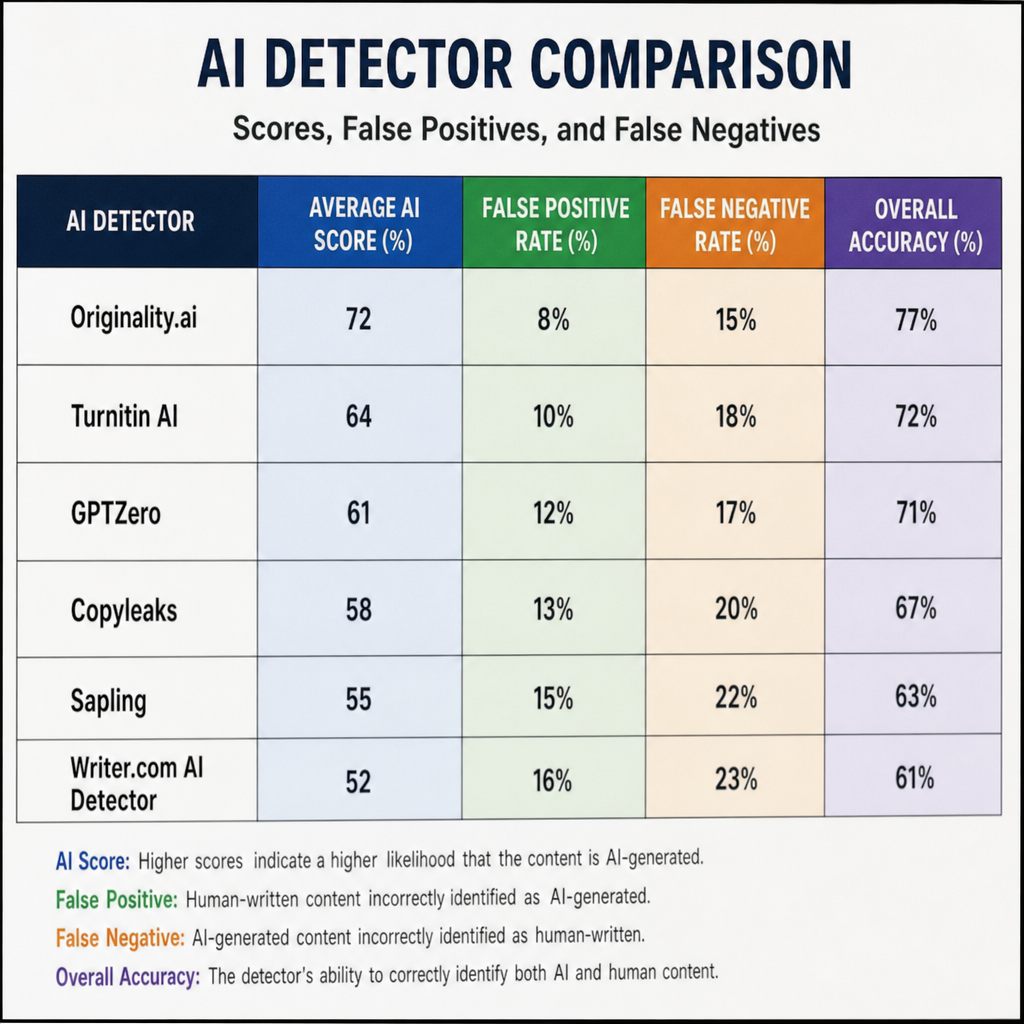
There is no single “most accurate” AI detector for every use case. Some studies and benchmarks have found strong performance from tools such as Copyleaks, Turnitin, Originality.ai, and GPTZero, but rankings change depending on the dataset, language, writing genre, AI model, and scoring threshold. The better question is not “what are the most accurate ai detectors,” but “which detector has been tested on writing like mine, and what are its false-positive and false-negative rates?”
For example, the 2023 study of 16 detectors identified Copyleaks, Turnitin, and Originality.ai as high-performing across its document sets. A separate computing-education comparison of eight public tools found Copyleaks most accurate in that particular test, GPTKit best for reducing false positives, and GLTR most resilient. These findings are useful, but they are not universal rankings for every classroom, workplace, language, or content type. (doi.org)
A fair evaluation should ask:
- What kind of writing was tested? Student essays, scientific abstracts, blog posts, code explanations, and business copy behave differently.
- Which AI models were included? A benchmark built around older GPT outputs may not reflect newer models or other systems.
- Were mixed and edited texts tested? Real-world documents often include both human and AI-assisted elements.
- How were false positives handled? A tool that catches AI but regularly flags human writing may be too risky for high-stakes use.
- Is the methodology transparent? Independent testing is easier to trust than a headline accuracy claim without a public corpus or clear method.
If you need an AI detector for operational use, test several tools on your own known samples before relying on any one score. Include authentic human writing, AI-generated writing, lightly edited AI writing, and AI-assisted human writing. That internal benchmark will tell you more than a generic “best detector” list.
Responsible ways to use AI detection tools
The responsible use of ai detection tools starts with humility. A detector can support a review process, but it should not replace human judgment, documentation, or conversation. This is especially important in education, where a mistaken accusation can damage trust between students and instructors.
Use this checklist before acting on an AI score:
- Read the flagged passage yourself. Look for sudden changes in voice, unexplained claims, missing process work, or inconsistencies with prior writing.
- Compare with known samples. If possible, review earlier drafts, outlines, notes, version history, or previous work from the same writer.
- Ask about process. A short conversation about sources, decisions, and revisions often reveals more than a detector score.
- Check the policy first. Some organizations allow AI for brainstorming, editing, translation, or accessibility support.
- Avoid single-tool decisions. If the stakes are meaningful, one detector score is not enough.
- Document uncertainty. Use language like “flagged for review,” not “proven AI-generated.”
- Create an appeal path. Writers should be able to provide drafts, notes, research logs, or explanations.
For publishers and marketing teams, detectors can help identify content that may need deeper editing, source verification, or originality review. For schools, they may help identify submissions worth discussing. In both cases, the next step should be evaluation, not automatic punishment.
What to do if your writing is falsely flagged
If your work is flagged as AI-generated and you wrote it yourself, stay calm and focus on evidence. Do not try to “beat” the detector by making random edits; that can make your writing worse and may create more confusion. Instead, gather proof of your process.
Useful evidence may include:
- Draft history from Google Docs, Microsoft Word, Notion, or another writing platform.
- Notes, outlines, source lists, annotations, or research logs.
- Earlier versions with visible revisions.
- Screenshots showing timestamps or version changes.
- A brief explanation of your writing process and source decisions.
- Prior writing samples that show a similar voice or style.
If you used AI in an allowed way, be specific. For example, say whether you used it to brainstorm topics, simplify a sentence, check grammar, translate a phrase, or generate a first draft. The important point is to connect your actions to the relevant policy.
If you are an educator, manager, or editor, give the writer a meaningful opportunity to respond. A high AI score may feel persuasive, but research on bias and false positives shows why process evidence matters. A person who can explain their argument, sources, structure, and revisions may be demonstrating authorship more reliably than a detector can.
Better alternatives to relying on detection alone
The long-term solution is not just better detection. It is better writing process design. When assignments, workflows, and editorial systems make authorship visible, organizations do not have to rely as heavily on after-the-fact guessing.
In education, that might mean requiring outlines, annotated bibliographies, in-class writing, oral defenses, draft checkpoints, reflection notes, or revision memos. These practices make learning more visible and reduce the value of submitting a polished product with no process behind it.
In content teams, it can mean clearer AI-use policies, source requirements, fact-checking steps, editorial review, and documentation of prompts or AI-assisted stages. A detector may still be part of the workflow, but it becomes a quality-control signal rather than the foundation of trust.
For individual writers, the best protection is a transparent process. Keep drafts. Save notes. Track sources. Write in a voice you can explain. If you use AI, use it in ways permitted by your school, client, employer, or publication, and be ready to describe what you did.
The takeaway
So, are AI detectors accurate? Sometimes, under the right conditions. But the broader research says ai detector accuracy is uneven, context-dependent, and vulnerable to both false positives and false negatives.
The smartest approach is not to ignore AI detection tools or blindly trust them. Use them as screening aids, interpret their scores carefully, and pair them with human review, process evidence, clear policies, and fairness safeguards. In a world where human and AI-assisted writing increasingly overlap, the most accurate judgment will rarely come from a percentage alone.