Exploring the Future of AI Novel Writing
AI is changing how fiction gets planned, drafted, revised, and published, but it is not replacing the human imagination at the heart of a memorable novel.
In this guide
Exploring the Future of AI Novel Writing
AI is changing how fiction gets planned, drafted, revised, and published, but it is not replacing the human imagination at the heart of a memorable novel. For writers, the real opportunity is learning how to use an ai novel writer as a creative partner: one that can suggest possibilities, organize ideas, challenge weak scenes, and keep momentum moving when the blank page feels too quiet.
Whether you are experimenting with an ai story generator for the first time or comparing different kinds of novel writing software, the future of AI-assisted fiction will belong to writers who stay intentional. The best results come from combining machine speed with human taste, emotional insight, and narrative judgment.
What will AI novel writing actually change?
AI novel writing will change the process more than the purpose of storytelling. A novel still needs voice, tension, character desire, emotional consequence, and a reason for readers to turn the page. What AI changes is how quickly a writer can explore options before choosing the one that feels right.
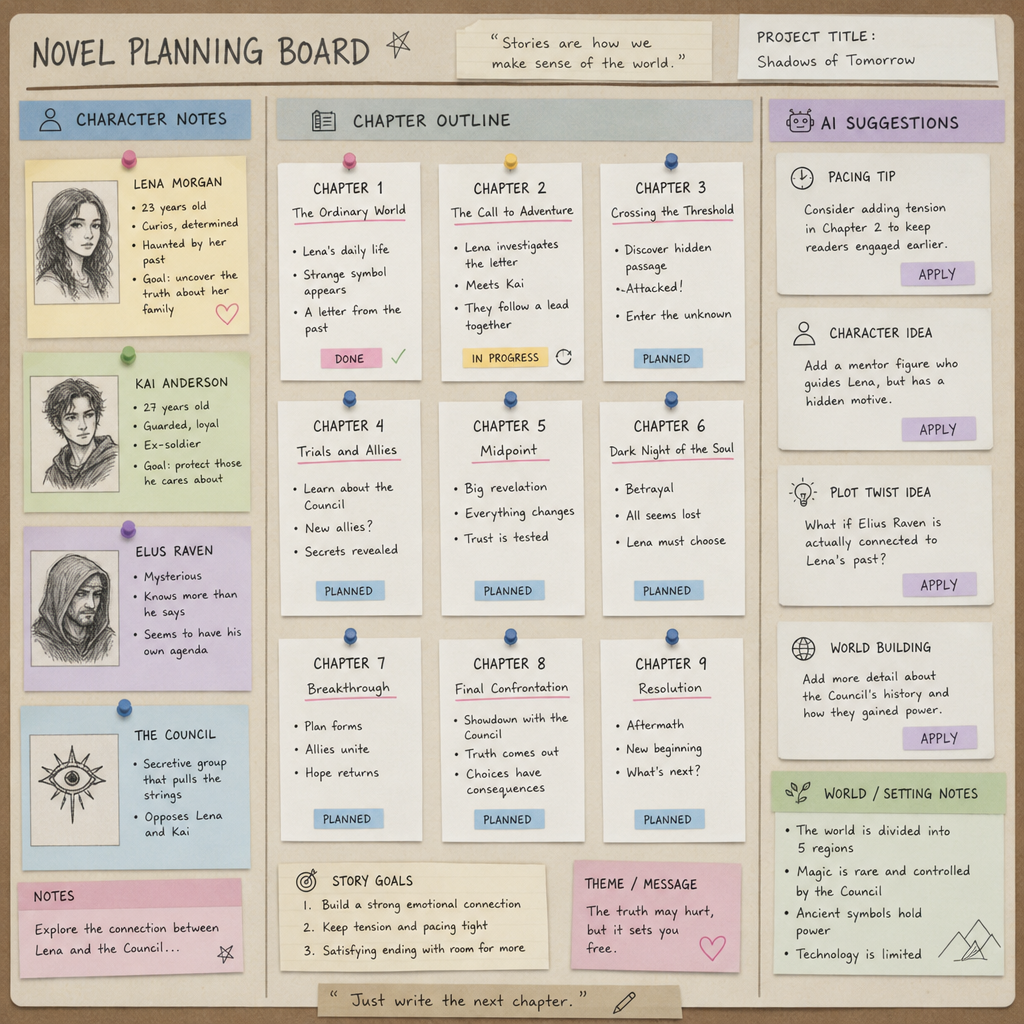
Instead of staring at a vague idea for weeks, an author can ask an ai writing assistant to help shape a premise, test several plot directions, or generate possible conflicts for a protagonist. A chapter that feels flat can be examined from multiple angles: pacing, dialogue, stakes, sensory detail, or point of view. This does not mean the AI becomes the author. It means the author has a tireless brainstorming partner available during the messy middle of the creative process.
That shift matters because writing a novel is not one task. It is hundreds of smaller decisions: who wants what, what blocks them, where a scene begins, what information to reveal, what to withhold, and how each chapter earns its place. AI tools can make those decisions easier to see, compare, and refine.
The rise of the AI-assisted author
The most interesting future is not “AI versus writers.” It is the rise of the AI-assisted author: a person who uses technology to reduce friction without giving up creative control. This kind of writer may use AI for structure, prompts, summaries, continuity checks, and revision ideas while still making every meaningful artistic choice.
For example, a fantasy writer might use an ai novel writer to map political factions, invent possible myths, or create a list of scene complications. A romance writer might ask for alternate meet-cute setups, emotional beats for a reconciliation scene, or ways to deepen internal conflict. A thriller writer might use AI to test whether a clue is too obvious, too hidden, or placed too late.
The strongest writers will not accept every suggestion. They will learn to reject the ordinary, reshape the useful, and notice when the machine offers a pattern instead of a surprise. AI can produce language quickly, but fiction succeeds when language serves meaning. That final layer of taste belongs to the author.
Practical ways writers are already using AI
An ai writing assistant can support almost every stage of a novel, but it works best when the writer gives it a clear job. Vague prompts tend to create vague output. Specific requests produce material that is easier to evaluate, edit, and transform.
Here are practical uses that fit naturally into a writer’s workflow:
- Idea development: Turn a loose concept into several possible premises, each with a central conflict and genre direction.
- Character discovery: Generate interview questions, contradictions, fears, habits, and backstory possibilities.
- Plot expansion: Explore turning points, midpoint reversals, subplot ideas, and possible endings.
- Scene planning: Break a chapter into beats so each moment has a purpose.
- Dialogue testing: Try different emotional tones for the same conversation.
- Continuity support: Summarize what has happened so far and identify details that may need tracking.
- Revision prompts: Ask what might be missing from a scene: urgency, setting, motivation, conflict, or consequence.
- Marketing preparation: Draft loglines, back-cover copy, genre descriptions, or reader-facing summaries for later refinement.
This is where novel writing software may become more powerful over time. Instead of acting only as a place to type pages, future platforms may combine outlining, character databases, research notes, manuscript organization, and AI-powered feedback in one workspace. The goal should not be to automate the novel away. The goal should be to help the writer see the novel more clearly.
Where AI helps most in the creative process
AI is especially useful when a writer needs volume, variation, or perspective. It can generate twenty possible scene openings, five alternate motives for a villain, or a list of questions a developmental editor might ask. Most of those suggestions may not be perfect, but they can loosen a stuck imagination.
Brainstorming without waiting for inspiration
Writers often lose time because they are waiting for the “right” idea. AI can help by making the wrong ideas visible sooner. Once you see ten weak possibilities, it becomes easier to identify the one with energy.
This is one of the most valuable uses of an ai story generator. It can create raw creative material quickly, giving the writer something to argue with, revise, or combine. Sometimes the AI’s suggestion is not the answer, but it points toward the answer.
Building structure from creative chaos
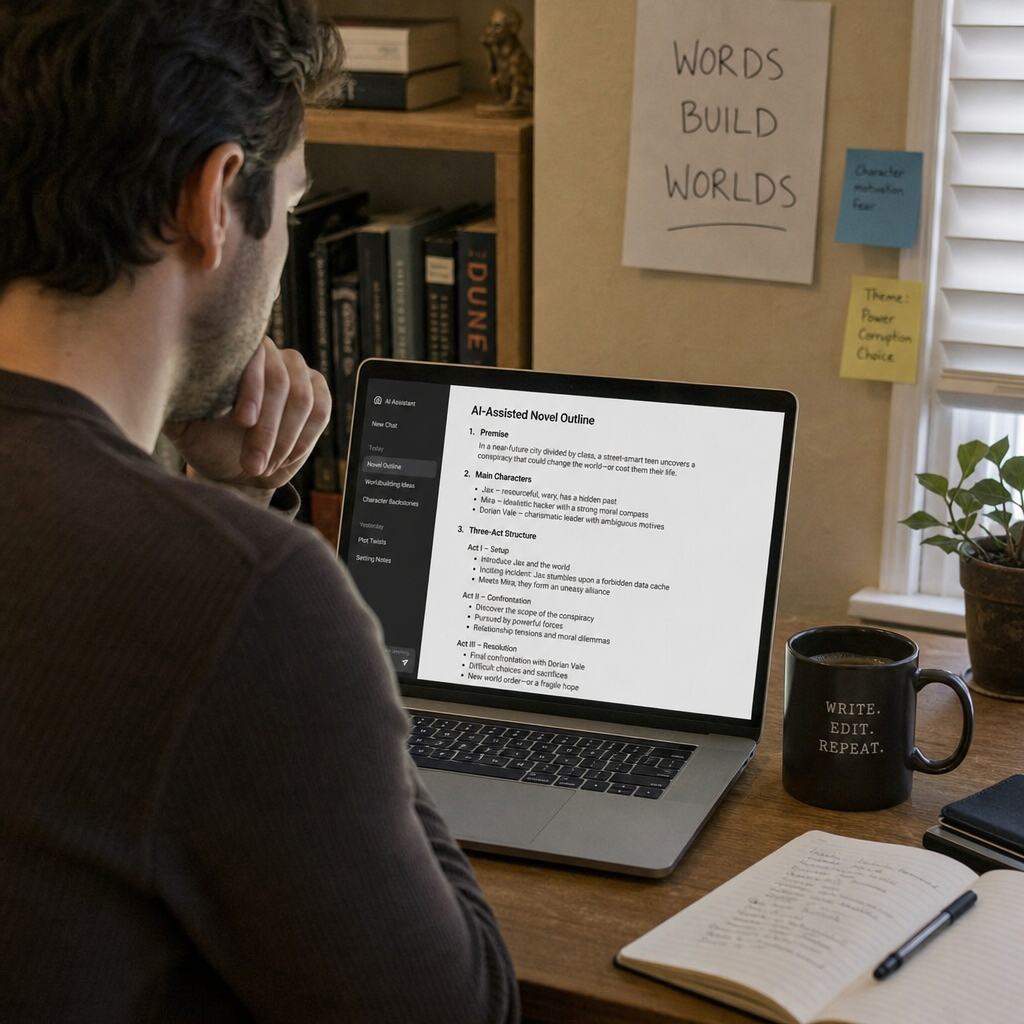
Many novelists begin with fragments: a character, a setting, an ending, or a single vivid scene. AI can help arrange those fragments into a possible shape. It can suggest three-act structures, chapter arcs, mystery clue sequences, or emotional progressions.
Still, structure is not a cage. A good outline gives the writer a path while leaving room for discovery. The author should treat AI-generated outlines as drafts of a map, not orders from a machine.
Revising with a second set of eyes
Revision is where AI may become most valuable. A writer can ask whether a scene has a clear goal, whether the conflict escalates, or whether a character’s reaction feels consistent with previous chapters. AI can also help summarize a chapter, which makes it easier to spot whether the actual focus matches the intended focus.
The writer should remain cautious. AI feedback is not the same as expert editorial judgment, and it may miss nuance. But as an early revision tool, it can help reveal weak spots before a manuscript goes to beta readers, critique partners, or professional editors.
The limits writers should not ignore
AI can be impressive, but it has limits that matter deeply in fiction. It may default to familiar tropes, smooth but generic prose, or emotional beats that sound plausible without feeling earned. It may also misunderstand continuity, flatten voice, or suggest plot turns that create more problems than they solve.
A novel is not just a sequence of events. It is an emotional design. Readers care because they sense intention behind the choices: the right image at the right time, the line of dialogue that reveals more than it says, the ending that feels both surprising and inevitable. AI can assist with pieces of that design, but it cannot fully replace lived perspective, moral imagination, or artistic obsession.
Writers should also pay attention to originality and ownership. If you use AI, revise heavily. Add your voice, your experience, your structure, and your standards. The more personal the final work becomes, the less it feels like generic output and the more it becomes a story only you could have shaped.
Free tools, unlimited promises, and realistic expectations
Searches for a free ai novel writer or an ai novel writer free unlimited option are common because many writers want to experiment before paying for software. That makes sense. Trying a tool at low cost can help you understand whether AI fits your workflow.
However, “free” and “unlimited” should be approached with realistic expectations. Some tools may limit word count, features, saved projects, model quality, export options, or long-form memory. Others may be useful for brainstorming but less reliable for full manuscript development. A free ai novel writer can be a great starting point, but serious drafting often requires careful organization beyond what a simple generator provides.
Before depending on any platform, consider:
- Project length: Can it handle long manuscripts, or only short prompts?
- Continuity: Does it remember characters, timelines, and world details reliably?
- Export options: Can you move your work into other formats easily?
- Privacy: Are you comfortable with how your text may be stored or used?
- Revision control: Can you compare versions or recover earlier drafts?
- Creative flexibility: Does it support your genre, tone, and preferred workflow?
The best tool is not always the one with the biggest promise. It is the one that helps you write more clearly, consistently, and confidently.
How to use an AI novel writer without losing your voice
Using a novel writer ai tool well requires direction. If you let the tool make all the choices, the result may sound polished but impersonal. If you treat it like a collaborator you manage, the output becomes more useful.
Start by defining your own creative rules before asking for help. Know the emotional core of the story, the type of ending you want, the themes you care about, and the kind of reader experience you are trying to create. Then use AI to explore options inside those boundaries.
A practical workflow might look like this:
- Write the premise yourself. Keep it short, specific, and emotionally focused.
- Ask AI for alternatives. Request several plot directions, not one final answer.
- Choose what feels alive. Keep only the ideas that deepen your original intention.
- Draft key scenes in your own voice. Use AI for prompts or structure, not as a substitute for your strongest writing.
- Use AI for revision questions. Ask what is unclear, slow, repetitive, or emotionally thin.
- Edit line by line. Replace generic phrasing with concrete detail, rhythm, and personality.
- Get human feedback. Use critique partners, beta readers, or editors when possible.
This approach keeps the writer in command. The AI helps generate and evaluate possibilities, but the author decides what belongs in the book.
The future of novel writing software
The next generation of novel writing software will likely feel less like a blank document and more like a creative studio. Writers may be able to move between manuscript pages, character profiles, timelines, research notes, worldbuilding files, and AI suggestions without losing context. For long projects, that kind of organization could be just as valuable as text generation.
Imagine opening a chapter and instantly seeing unresolved plot threads, character goals, timeline notes, and previous emotional beats. Imagine asking your ai writing assistant to identify scenes where a supporting character disappears for too long, or to summarize how the protagonist’s motivation changes across the manuscript. These features would not write the novel for you, but they could make revision more manageable.
The challenge will be balance. Too much automation can make writing feel mechanical. Too little context makes AI output shallow. The best software will respect the writer’s authority while offering intelligent support at the right moment.
Ethical and artistic questions will shape adoption
As AI becomes more common in fiction, writers, publishers, readers, and platforms will continue asking difficult questions. How much AI assistance should be disclosed? What counts as original authorship? How should training data be handled? What standards should contests, publishers, and marketplaces apply?
These questions do not have one simple answer for every writer. Some authors may use AI only for brainstorming. Others may use it for outlining or revision support. Some may avoid it entirely for artistic or ethical reasons. What matters is that writers make conscious choices rather than drifting into convenience without considering the implications.
Readers ultimately respond to trust. If a book feels hollow, derivative, or careless, it will struggle no matter how it was produced. If a story feels vivid, intentional, and emotionally true, readers are more likely to care about the experience itself. AI may change the production process, but it will not remove the need for craft.
A writer-first checklist for AI-assisted fiction
Before bringing AI deeper into your novel process, use this checklist to keep the work grounded:
- I know what the story is really about beyond the plot.
- I can describe my protagonist’s desire, fear, and central change.
- I use AI suggestions selectively, not automatically.
- I revise generated material until it sounds like my own work.
- I track continuity in characters, setting, timeline, and rules.
- I protect sensitive drafts and understand the tool’s privacy terms.
- I seek human feedback for emotional impact and reader experience.
- I treat AI as support, not as the source of my creative identity.
This checklist is simple, but it protects the most important part of the process: authorship. AI can speed up exploration, but it cannot care about the story for you.
Human imagination remains the center
The future of AI novel writing is not a single destination. It will be a spectrum of tools, habits, debates, and creative experiments. Some writers will use AI lightly. Others will build entire workflows around it. Many will move back and forth depending on the project.
What should remain constant is the writer’s responsibility to choose with intention. A strong novel is not impressive because it contains many words. It is memorable because those words create meaning, tension, beauty, fear, hope, or recognition. An ai novel writer can help you reach more possibilities faster, but the final shape of the story still depends on human judgment.
For writers willing to learn the tools without surrendering their voice, the future is promising. AI can make drafting less lonely, revision less chaotic, and experimentation more accessible. But the story still needs a mind behind it, a heart inside it, and a writer brave enough to decide what matters.