Comparison of GPTZero and ZeroGPT Performance
A GPTZero and ZeroGPT performance comparison is an evaluation of how well two popular AI text detection platforms identify likely machine-written content
In this guide
Comparison of GPTZero and ZeroGPT Performance
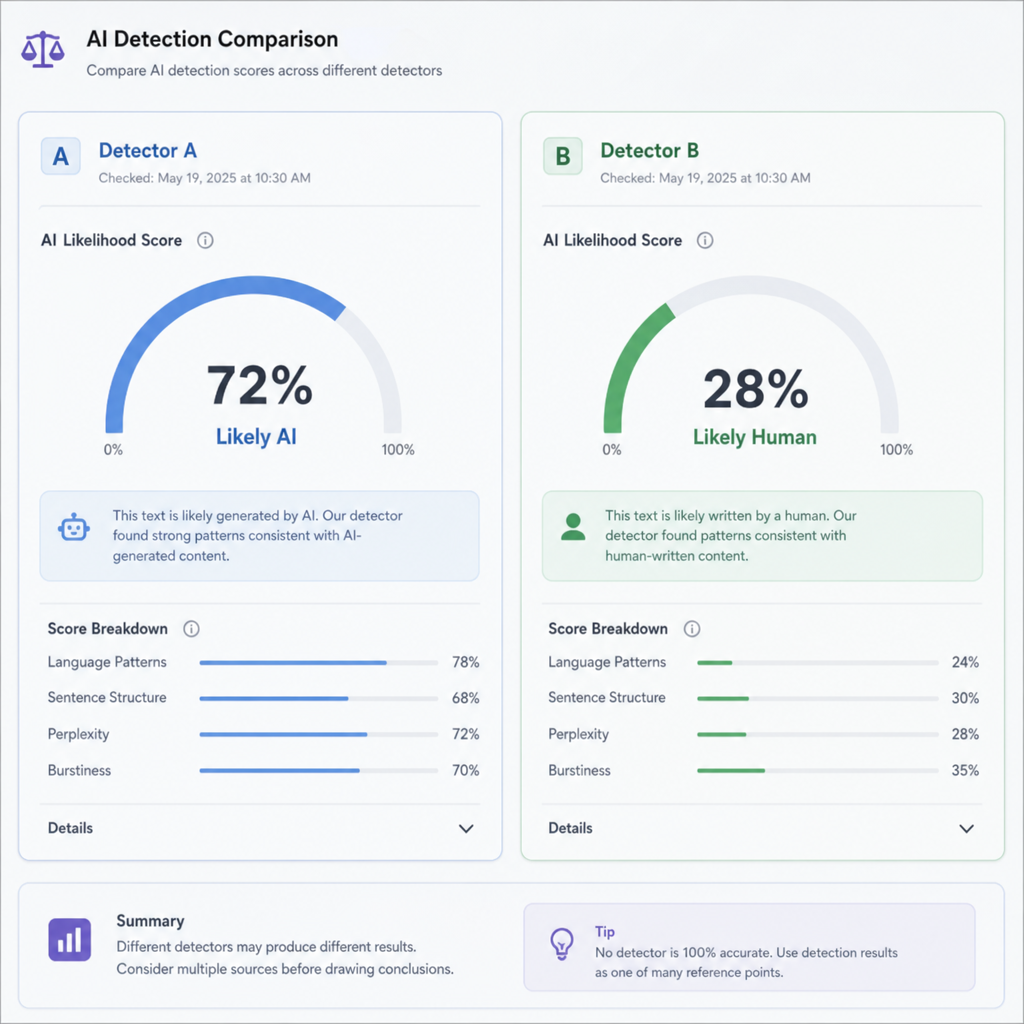
A GPTZero and ZeroGPT performance comparison is an evaluation of how well two popular AI text detection platforms identify likely machine-written content, explain their confidence, and support real-world review workflows. In practical terms, GPTZero vs ZeroGPT is not only about which tool gives a higher AI percentage; it is about accuracy, false positives, interpretability, workflow fit, and how carefully users act on the result. Both tools can be useful in ai text detection, but neither should be treated as a single source of truth.
What does GPTZero vs ZeroGPT performance mean?
GPTZero vs ZeroGPT performance means how reliably each detector separates human-written text from AI-generated text across different writing samples, models, lengths, languages, and editing conditions. A useful comparison looks at more than a final score: it considers confidence levels, sentence-level explanations, document length requirements, susceptibility to paraphrasing, and the risk of accusing human writers incorrectly.
AI detection is probabilistic, not the same as plagiarism detection. GPTZero’s own support documentation states that current AI detection is predictive because both AI and human language keep changing, and it advises against using a detection result as the only proof for academic punishment or discipline. (support.gptzero.me) That single point should shape every serious gptzero review or ZeroGPT evaluation: the output is evidence to investigate, not a verdict.
How do AI text detection tools measure likely AI writing?
AI text detection tools typically analyze patterns in language that may differ between human and machine-written text. These patterns can include consistency, predictability, sentence structure, vocabulary distribution, and similarities to known AI-generated examples. Modern tools increasingly use trained classification models rather than simple “perplexity” checks, because newer AI models and human editing can blur older signals.
GPTZero says it works across models including ChatGPT, GPT-3, GPT-4, GPT-5, GPT-6, Gemini, Claude, and AI services based on those models, and it notes that performance improves when more text is submitted. It also says its dataset is primarily English prose written by adults, which matters because detector performance can shift when the writing is short, procedural, heavily edited, multilingual, or outside the model’s training strengths. (gptzero.me)
ZeroGPT describes its DeepAnalyse™ technology as a multi-stage approach trained on internet text, educational datasets, and proprietary synthetic AI datasets, with coverage across major LLM families such as ChatGPT, Gemini, Grok, Claude, DeepSeek, and LLaMA. Its site also claims 98.4% detection accuracy, a false positive rate under 1%, and coverage of 35+ LLM families; those are vendor claims and should be weighed against independent testing. (zerogpt.com)
Defining characteristics of a useful AI detector
A strong AI detector is not simply the one that produces the most confident answer. The best AI tools for review workflows usually offer:
- Transparent confidence language: The score should communicate uncertainty instead of implying perfect certainty.
- Low false-positive risk: Human-written work should not be flagged casually, especially in schools or workplaces.
- Useful granularity: Sentence or paragraph indicators help reviewers inspect the text rather than react to one overall label.
- Document-level reliability: Longer samples usually give detectors more signal than isolated sentences.
- Workflow support: Reports, history, integrations, APIs, or browser tools can matter as much as raw detection.
- Clear limitations: A trustworthy tool explains where its detector may fail.
GPTZero performance profile
GPTZero positions itself strongly for educators, writing review, and authorship conversations. Its public FAQ says it is fine-tuned for student writing and academic prose, and it recommends using writing reports and holistic assessment rather than punishment based only on classifier output. (gptzero.me) That makes GPTZero attractive when the goal is not just to detect AI, but to understand the writing process.
A notable GPTZero feature is Writing Replay, available through its Chrome extension. GPTZero says the feature can record typing on supported sites and generate a shareable replay to help prove a draft was written by the user; it records an ordered changelog of insertions, deletions, and paste events rather than activity from unrelated tabs or fields. (support.gptzero.me) This matters because process evidence can be more constructive than arguing about a probability score after the fact.
GPTZero also offers AI Vision through its Chrome extension, which scans supported platforms as a user browses and tags content as likely AI or human. GPTZero states that AI Vision works on platforms including Reddit, X, LinkedIn, Medium, and Substack. (support.gptzero.me) For reviewers who regularly evaluate online writing, that makes GPTZero more of a workflow layer than a one-page detector.
In terms of interpretation, GPTZero provides confidence categories and says its confidence settings are designed to maintain high accuracy while keeping false positives low. Its documentation frames “AI percentage” as a probability-style estimate rather than a literal measurement of how many words were written by AI. (support.gptzero.me) This is a practical advantage for users who need a more careful gptzero review process.
ZeroGPT performance profile
ZeroGPT is built around fast scanning, accessibility, and a broad tool suite. Its site promotes AI detection alongside related tools such as plagiarism checking, grammar checking, paraphrasing, summarizing, translation, word counting, citation generation, and AI image or video detection. (zerogpt.com) This makes zerogpt features appealing for users who want multiple writing utilities in one platform.
ZeroGPT also promotes batch file uploads and API access for several tools, including AI detection, plagiarism checking, paraphrasing, summarizing, grammar and spell checking, chatbot functions, and translation. (zerogpt.com) For teams that need high-volume checking or simple integration, this can be more convenient than manually pasting text into a detector.
Performance-wise, ZeroGPT often stands out because it presents confident and easy-to-understand results. However, easy interpretation is not the same as guaranteed accuracy. Like all AI detectors, ZeroGPT can be affected by text length, human revision, paraphrasing, genre, language, and the difference between “AI-assisted” and “AI-written.”
The main performance dimensions
A fair comparison should separate raw detection from practical reliability. The following dimensions are more useful than asking which tool is “best” in isolation:
|
Performance factor |
GPTZero |
ZeroGPT |
Practical implication |
|---|---|---|---|
|
Primary fit |
Education, authorship review, writing process evidence |
Fast AI checks and multi-tool writing workflows |
Choose based on the decision you need to make. |
|
Result interpretation |
Emphasizes confidence and probabilistic limits |
Presents direct detection scores and broad claims |
Direct scores are convenient, but confidence context matters. |
|
Workflow features |
Writing Replay, AI Vision, Chrome extension, reports |
Batch uploads, API access, writing tools, messaging integrations |
GPTZero leans toward review process; ZeroGPT leans toward tool breadth. |
|
Risk management |
Publicly cautions against punitive use as sole evidence |
Promotes accuracy and low false-positive claims |
Both require human review before action. |
|
Best use case |
Schools, editors, reviewers needing context |
Marketers, publishers, and teams wanting quick screening |
Neither replaces policy, documentation, or direct conversation. |
Independent research shows why context matters. A 2026 study of Persian-language journal abstracts found stronger overall results for ZeroGPT than GPTZero under its test conditions, but also found that both tools struggled severely to identify human-written text, creating false-positive concerns. (aip.vse.cz) Another study evaluating watermarking, ZeroGPT, and GPTZero on essays found that ZeroGPT had both high false-positive and false-negative rates, while paraphrasing AI-generated text significantly increased false negatives across detectors. (arxiv.org)
Is GPTZero better than ZeroGPT?
GPTZero may be better than ZeroGPT when the review process needs more context, especially in education, authorship verification, and sensitive decisions involving student or employee work. Its emphasis on confidence, writing reports, Writing Replay, and warnings against punitive use makes it more suitable when the reviewer must explain a decision rather than simply sort content into AI or human categories. (gptzero.me)
The answer to is gptzero better than zerogpt therefore depends on the use case. If you need a detector that supports a broader authorship conversation, GPTZero has stronger process-oriented features. If you only need a fast initial scan, the advantage may be less clear.
GPTZero is especially useful when:
- You need to review student writing with caution.
- You want confidence language and interpretive context.
- You need browser-based review or real-time online scanning.
- You want writing-process evidence, not just a final AI score.
- You are working with longer English prose where the detector has more text to assess.
Is ZeroGPT better than GPTZero?
ZeroGPT may be better than GPTZero when speed, tool variety, batch workflows, and broad platform features matter more than authorship-process evidence. Its platform includes multiple writing and detection utilities, promotes batch uploads, and offers API access across several tools, which can be useful for teams handling many documents or building AI checks into a larger workflow. (zerogpt.com)
The answer to is zerogpt better than gptzero is yes for some operational needs, but not automatically for high-stakes judgment. ZeroGPT’s direct interface and related writing tools can make it efficient for content teams, publishers, or marketers who want a quick first pass. For disciplinary or legal-style decisions, however, independent verification and human review remain essential.
ZeroGPT is especially useful when:
- You want AI detection plus grammar, summarizing, paraphrasing, translation, and plagiarism-related tools in one place.
- You need batch file uploads or API-based workflows.
- You are screening content at scale before deeper review.
- You prefer simple, direct output for triage.
- You are comparing multiple tools and want another signal alongside GPTZero.
Practical examples and common misconceptions
AI detection becomes more useful when it is applied as part of a structured review. The biggest mistakes happen when people treat a score as final proof, ignore the writing context, or test very short samples and expect reliable conclusions.
Common practical uses include:
- Classroom review: An instructor checks a suspicious essay, then asks for drafts, notes, oral explanation, or writing history before drawing conclusions.
- Editorial screening: An editor runs submitted articles through AI text detection to decide which pieces need closer human review.
- Content quality control: A marketing team checks whether outsourced drafts look overly generic or machine-like before editing.
- Authorship support: A writer uses Writing Replay-style evidence to show how a draft developed over time.
- Tool benchmarking: A team tests GPTZero and ZeroGPT on known human, AI-generated, and AI-assisted samples before choosing a workflow.
Common misconceptions include:
- “A 90% AI score means 90% of the words are AI-written.” Usually, it means the detector believes the text resembles AI writing with a certain confidence.
- “One detector result is proof.” It is not; it is a signal for further review.
- “Human editing always beats detectors.” Editing can reduce signals, but results vary by tool, text, and editing style.
- “False positives are rare enough to ignore.” Even low false-positive rates can matter when the consequence is serious.
- “The same tool performs equally well in every language.” Performance can vary sharply by language, genre, and dataset.
A responsible testing checklist
Before deciding which detector belongs in your workflow, run your own small benchmark. This is the most practical way to move beyond marketing claims and generic lists of the best ai tools.
Use this checklist:
- Collect known human-written samples from your actual use case.
- Collect known AI-generated samples using the models your audience is likely to use.
- Include AI-assisted drafts that were edited by a human.
- Test long documents, short passages, and borderline cases separately.
- Record false positives and false negatives, not just overall accuracy.
- Compare sentence-level explanations against the text itself.
- Decide what action, if any, each confidence level should trigger.
- Never use a detector as the only evidence for punishment, rejection, or accusation.
This approach turns gptzero vs zerogpt from a brand debate into a risk-management decision. A detector that works well on one benchmark may perform poorly on another, especially when language, genre, or editing style changes.
Final comparison
GPTZero is generally the stronger choice for cautious authorship review, education-oriented workflows, and situations where confidence, reports, and writing-process evidence matter. ZeroGPT is generally the stronger choice for quick screening, broad writing-tool access, batch workflows, and teams that want AI detection alongside other utilities.
The safest conclusion is that neither tool is universally “better.” GPTZero and ZeroGPT are best understood as different AI text detection systems with different strengths: GPTZero emphasizes interpretability and process, while ZeroGPT emphasizes convenience and platform breadth. For serious decisions, use either tool as one signal among several, verify with human judgment, and document the reasoning behind any action.