Understanding Turnitin's Green Score: A Guide
A green Turnitin score usually means your submission has a relatively low level of matching text, but it does not automatically prove that the work is
In this guide
Understanding Turnitin's Green Score: A Guide
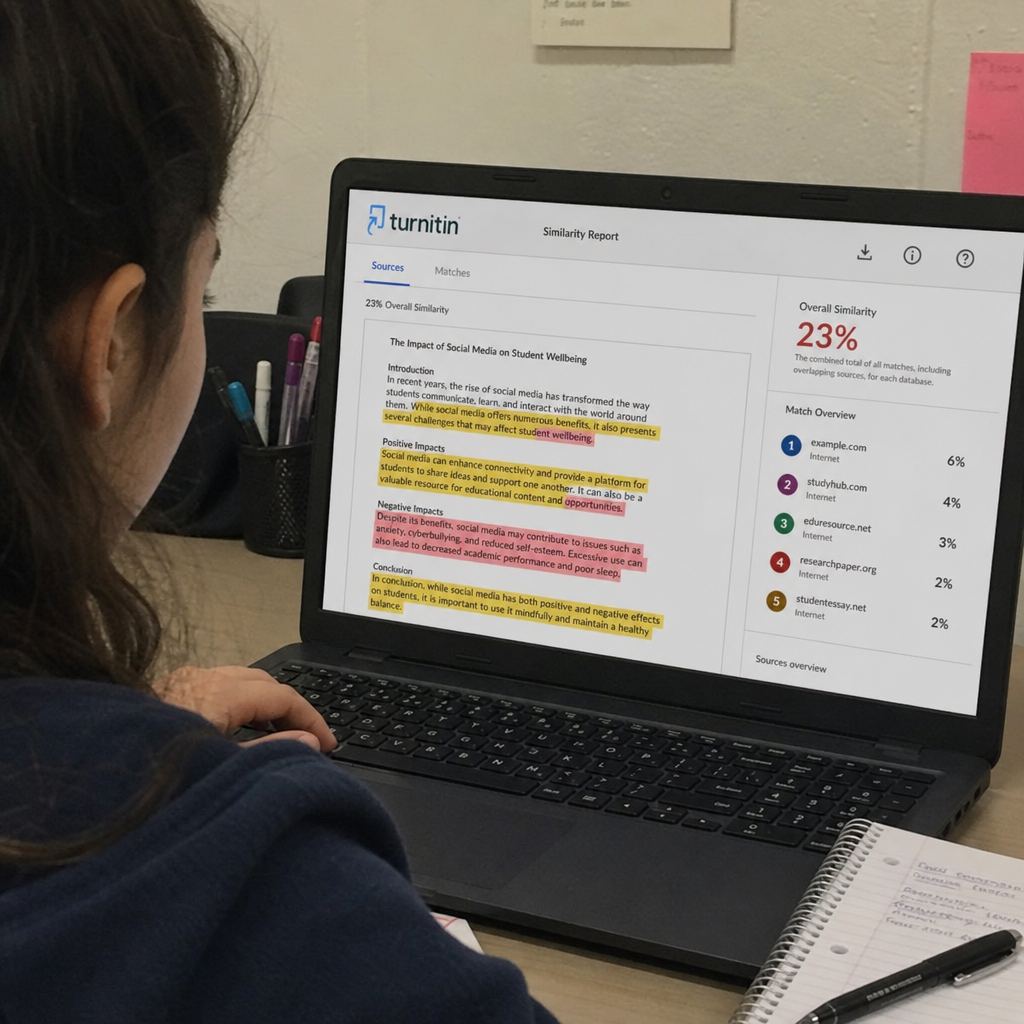
A green Turnitin score usually means your submission has a relatively low level of matching text, but it does not automatically prove that the work is plagiarism-free. The real value of a Turnitin report is in the details: which passages match, where they match, and whether those matches are properly quoted, cited, or expected for the assignment. If you see green on Turnitin, treat it as a helpful signal—not the final word on academic integrity.
What does green mean on Turnitin?
Green on Turnitin means the Similarity Report has found matching or highly similar text in the range of one word to 24% of the submission, according to Turnitin’s student guidance. The score reflects similarity, not a direct plagiarism verdict, so a green result can still include passages that need better citation, paraphrasing, or review. (help.turnitin.com)
That distinction matters. A paper can be green because it uses a few correctly quoted sources, common phrases, assignment titles, or bibliography entries. Another paper can also be green while containing a smaller but serious citation problem, such as a copied paragraph that is not acknowledged. The percentage gives you a starting point, but the highlighted matches tell the more important story.
The green score is a similarity signal, not a grade
A Turnitin report compares a Turnitin submission against selected databases, such as internet content, student paper repositories, and academic publications, then highlights matching or similar text. Turnitin’s own guidance explains that similarity does not mean the work is necessarily plagiarized, because quoted, cited, and bibliographic material may also contribute to the score. (help.turnitin.com)
This is why instructors often review the report rather than relying only on the color. A green score may be acceptable in one class and concerning in another, depending on the assignment type. A research essay is expected to engage with sources, while a personal reflection or original lab response may require much more independent wording.
If you are a student, do not assume that green means “done.” If you are an educator, do not assume that green means “no issue.” The score is best understood as a prompt to look closer, especially at the largest matches and any uncited language.
How to read a green Turnitin report
The most useful way to review a green Turnitin report is to move from the overall score to the individual matches. Instead of asking only, “Is the number low enough?” ask whether each highlighted section makes sense for the assignment.
Use this simple review checklist:
- Check the biggest matches first. A single large match deserves more attention than several tiny matches from common phrases.
- Look at citation quality. If a highlighted passage uses another author’s ideas, make sure the source is cited in the required style.
- Review quotation marks. Exact wording from a source should normally be placed in quotation marks or block quote format, depending on length and citation style.
- Separate normal similarity from risky similarity. Reference lists, assignment prompts, titles, formulas, and standard terminology may appear as matches without indicating misconduct.
- Watch for patchwriting. A sentence that closely follows the source with only a few changed words may still need stronger paraphrasing.
- Confirm your instructor’s rules. Turnitin advises students to consult the instructor, syllabus, or institutional policy because acceptable thresholds vary by school, course, and assignment. (help.turnitin.com)
This process turns the plagiarism check into a learning tool. Rather than chasing a perfect percentage, you are checking whether your writing shows control over sources and gives credit where credit is due.
Why can a well-written paper still show green?
A well-written paper can show green because academic writing often includes source-based evidence, technical terms, quotations, and references that naturally overlap with existing material. In many assignments, a similarity score above zero is normal because students are expected to discuss published research or course materials.
For example, a literature review may include article titles, author names, quoted definitions, and recurring disciplinary language. A legal, medical, or scientific paper may use standard phrasing that is difficult or inappropriate to rewrite completely. Even a careful bibliography can influence the overall similarity score if the settings include references in the calculation.
This is where academic integrity becomes more nuanced than a color label. Strong academic writing does not avoid sources; it uses them responsibly. Your goal is to show where outside information ends and your own analysis begins.
What to do if your Turnitin submission is green
If your Turnitin submission comes back green, take a few minutes to review it before you relax. Green is usually reassuring, but it is still worth checking the highlighted text and source list.
A practical next step might look like this:
- Open the Similarity Report and scan the overall percentage.
- Review each highlighted passage in the paper, especially longer matches.
- Compare the match with your citation to confirm that the source is clearly acknowledged.
- Revise weak paraphrases by rewriting the idea in your own structure and voice, then citing the source.
- Keep necessary quotations only when the original wording is important, and format them correctly.
- Resubmit only if allowed by your course settings and deadline.
Be aware that resubmissions may not always generate instantly. Turnitin notes that overwritten or resubmitted papers may take up to 24 hours to produce a new Similarity Report, depending on the situation. (help.turnitin.com)
Common misunderstandings about green on Turnitin
Many students treat the green score as a pass/fail result, but that can create false confidence. The color is useful, yet it cannot understand assignment instructions, evaluate your argument, or decide whether a source was used ethically.
Here are a few common myths to avoid:
- “Green means there is no plagiarism.” Not necessarily. A small amount of uncited copying can still matter.
- “Zero is always best.” Not always. Turnitin’s student guide notes that zero similarity may mean the paper includes no source-based evidence, which can be a problem for many assignments. (help.turnitin.com)
- “Any match is bad.” Matches can come from quotations, citations, references, common wording, or required templates.
- “Only the percentage matters.” The context of each match matters more than the color alone.
- “Paraphrasing removes the need to cite.” Paraphrased ideas still need attribution when they come from another source.
Understanding these points helps students use Turnitin Originality tools more productively. The goal is not to “beat” the system. The goal is to submit work that is clear, honest, and properly supported.
Green scores and academic integrity
Academic integrity is about more than avoiding copied text. It includes honest research habits, accurate citation, responsible collaboration, and transparency about where ideas come from. A green Turnitin score can support that process, but it cannot replace your judgment or your instructor’s expectations.
Before submitting final work, ask yourself three questions: Did I clearly cite borrowed ideas? Did I use quotation marks when I kept exact wording? Did my own analysis, organization, and voice lead the paper? If the answer is yes, a green score is more likely to reflect responsible source use.
In the end, what does green mean on Turnitin? It means your paper has a low-to-moderate similarity range, but the report still deserves a careful review. Use the color as a guide, use the highlighted matches as evidence, and use your course rules as the final standard.