Understanding SafeAssign: A Comprehensive Guide
SafeAssign is a text comparison and originality review tool used in academic settings to help instructors and students identify overlap between submitted work
In this guide
Understanding SafeAssign: A Comprehensive Guide
SafeAssign is a text comparison and originality review tool used in academic settings to help instructors and students identify overlap between submitted work and existing sources. It is often discussed as a plagiarism checker, but its real value is broader: it supports better citation habits, stronger writing, and a clearer understanding of academic integrity. This guide explains what SafeAssign does, how to read similarity results, and how students can use the process to improve an essay before submission.
What does SafeAssign actually check?
SafeAssign checks submitted text against collections of academic papers, internet sources, institutional documents, and other available reference materials to identify matching or similar passages. The result is usually an originality report that highlights text overlap and provides a similarity score, helping instructors decide whether the writing is properly sourced, paraphrased, and cited. A match does not automatically mean plagiarism; it means the writing deserves closer review.
That distinction matters. A bibliography, a correctly quoted sentence, or a commonly used phrase may appear in a report even when the student has done nothing wrong. The purpose of a safeassign checker is not to punish every match, but to make visible where language may be too close to another source.
For students, this can be useful long before grading happens. When used as a learning tool, an originality checker can show where a draft needs better paraphrasing, clearer attribution, or more original analysis. For instructors, it creates a starting point for conversations about citation, research quality, and ethical writing.
SafeAssign as a learning tool, not just a detection tool
It is easy to think of SafeAssign only as a plagiarism checker, but that narrow view misses its educational purpose. Academic writing depends on using sources responsibly. Students are expected to engage with research, quote when necessary, paraphrase accurately, and add their own reasoning. A similarity checker can help reveal whether that balance is working.
A strong essay usually includes evidence from outside sources, so some similarity is normal. The important question is whether the matched material is handled correctly. Are direct quotes placed in quotation marks? Are ideas credited to the right author? Is the student adding interpretation instead of simply rearranging someone else’s wording?
SafeAssign can support academic integrity by making these questions easier to see. Rather than guessing whether a paragraph is too close to its source, students and instructors can look at highlighted passages and compare them with the original material. This turns a vague concern into a concrete writing issue.
How an originality report should be read
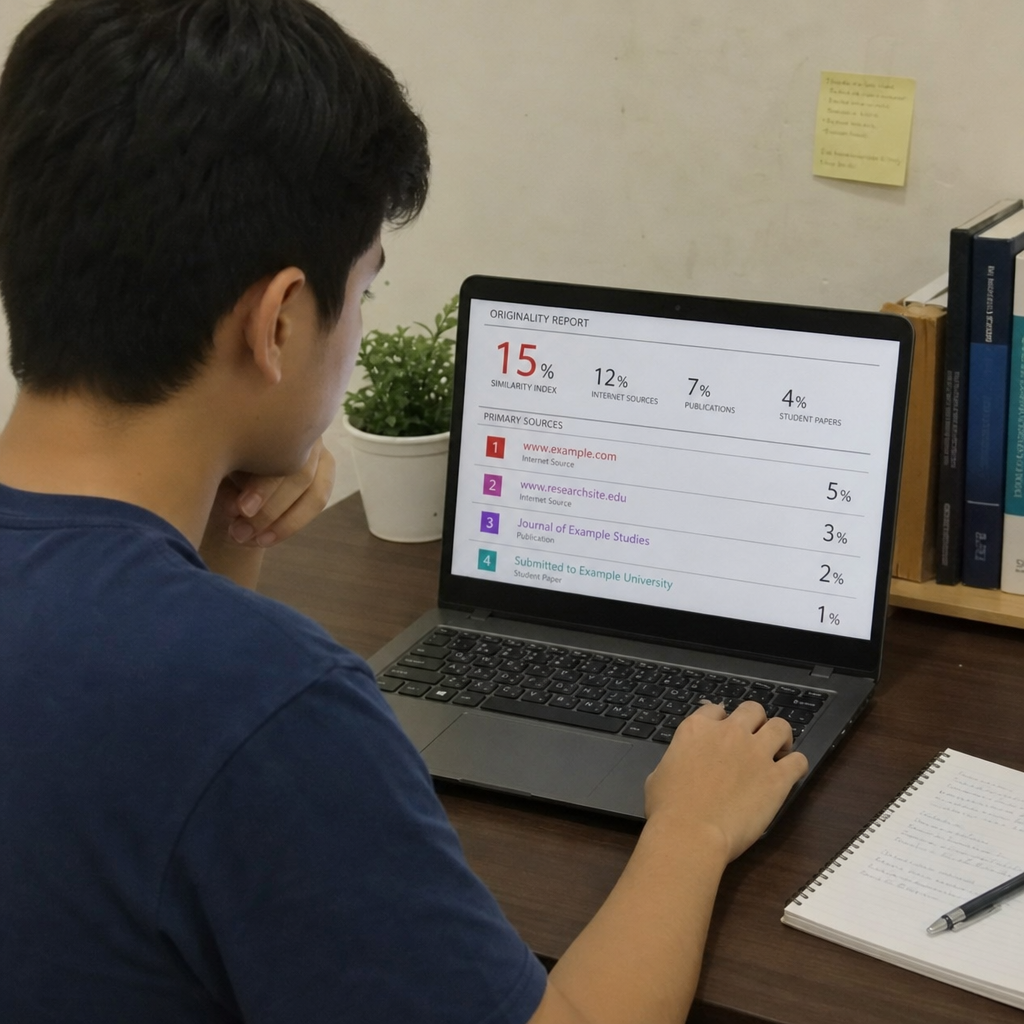
An originality report is not a final judgment. It is a map of possible overlap. The score may draw attention first, but the highlighted text and source links are usually more important than the number itself.
A high similarity score may come from poorly paraphrased content, excessive quoting, copied passages, or repeated template language. However, it may also include references, assignment prompts, common terminology, or properly cited material. A low score is not automatically proof that a paper is excellent, either. An essay could have few matches and still contain weak research, unsupported claims, or uncited ideas that were not found in the comparison database.
When reviewing a report, focus on context:
- Matched quotations: Are they marked clearly and cited correctly?
- Paraphrased material: Does it use genuinely new wording and structure, or does it follow the source too closely?
- Common phrases: Are the matches ordinary academic language, technical terms, or assignment instructions?
- Reference list matches: Are bibliography entries being counted in the similarity total?
- Large blocks of overlap: Do they suggest copying, overreliance on one source, or missing citation?
This is where human judgment remains essential. SafeAssign can identify text comparison results, but it cannot fully understand intent, assignment requirements, or the quality of a student’s argument.
Why is a similarity score not the same as plagiarism?
A similarity score is not the same as plagiarism because similarity only shows that text overlaps with existing material; plagiarism depends on how that material is used, credited, and represented. A properly quoted and cited passage may increase similarity without violating academic integrity, while an uncited paraphrase may be problematic even if the wording is not identical.
This is one of the most important points for students to understand. Plagiarism is about misrepresenting someone else’s words, ideas, structure, or work as your own. Similarity is about detectable overlap. The two can be related, but they are not identical.
For example, a research paper may naturally include the title of a law, a scientific phrase, or a quotation from a primary source. These matches can be legitimate. On the other hand, a paragraph that closely follows a source sentence by sentence may be a problem even if a few words have been changed.
A good essay checker or originality tool helps identify places to review. It does not replace the responsibility to write honestly, cite carefully, and understand the rules of the course or institution.
Common reasons text gets flagged
Students are often surprised when their work receives matches. In many cases, the issue is not deliberate copying but uncertainty about how academic writing works. Knowing the common causes can reduce stress and improve future drafts.
Overquoting instead of analyzing
Quotations are useful when the exact wording matters, but too many quotes can make an essay feel assembled rather than argued. If a paper leans heavily on quoted material, the similarity report may show frequent matches. The better approach is to quote selectively, then explain why the evidence matters in your own words.
Paraphrasing too closely
Changing a few words is not enough to create a strong paraphrase. Effective paraphrasing changes the wording, sentence structure, and emphasis while preserving the original meaning. It also includes a citation when the idea comes from a source. If SafeAssign highlights an entire paragraph that was meant to be paraphrased, the writer may need to step back, reread the source, and rewrite the idea from understanding rather than from the original sentence pattern.
Missing or unclear citations
Sometimes the writing is mostly original, but the source trail is incomplete. A student may mention an author in one sentence and then continue summarizing the same source for several lines without making it clear where the borrowed ideas end. Clear signal phrases, in-text citations, and consistent formatting help readers follow the boundary between source material and original analysis.
Reused work and duplicate submissions
SafeAssign may flag a student’s own previous writing if it has been submitted before. Many institutions treat unauthorized reuse of prior work as a form of academic misconduct, even when the student wrote the original paper. If you want to build on earlier research, ask the instructor what is allowed and cite or disclose previous work when required.
Practical ways to improve a draft before submission
SafeAssign is most helpful when students treat it as part of the writing process rather than a last-minute obstacle. If your course allows draft checking, review the report early enough to make meaningful revisions.
Use this checklist before turning in an essay:
- Review every large highlighted section. Look for long matches that may need rewriting, quoting, or clearer citation.
- Check each quotation. Confirm that quoted language has quotation marks, an accurate citation, and a purpose in the paragraph.
- Strengthen paraphrases. Rewrite from memory after reading the source, then compare your version against the original.
- Add your own analysis. After using evidence, explain what it proves and how it supports your thesis.
- Review the reference list. Make sure every cited source appears in the bibliography and every bibliography item is used in the essay.
- Follow assignment rules. Some instructors have specific expectations for source types, citation style, or acceptable collaboration.
These steps do more than lower a similarity score. They improve the quality of the paper by making the writer’s own thinking easier to recognize.
SafeAssign compared with other checking tools
SafeAssign is one option in a larger category of academic writing support tools. Students may also encounter a general plagiarism checker, grammar-focused essay checker, or independent similarity checker. Each tool has a slightly different purpose, and understanding those differences helps set realistic expectations.
|
Tool type |
Main purpose |
Best use |
|---|---|---|
|
SafeAssign checker |
Compares academic submissions with source databases |
Reviewing originality in a course setting |
|
Plagiarism checker |
Looks for copied or closely matched text |
Identifying passages that need citation or rewriting |
|
Originality checker |
Evaluates how much writing appears unique |
Draft review and academic integrity support |
|
Essay checker |
May review grammar, clarity, structure, or similarity |
Improving writing quality before submission |
|
Text comparison tool |
Compares one text directly against another |
Checking paraphrases against specific sources |
No tool should be treated as perfect. Databases vary, source access may differ, and automated systems may miss some issues while flagging harmless matches. The safest approach is to use technology as support while relying on careful writing habits.
How instructors use SafeAssign responsibly
For instructors, SafeAssign can help identify patterns that deserve attention, but responsible use requires context. A report should be reviewed alongside the assignment instructions, citation expectations, student level, and the actual highlighted passages. The score alone should not be the only basis for a serious academic decision.
Instructors may use reports to teach better research practices. For example, if many students show high overlap with the assignment prompt or the same source, the class may need clearer guidance on paraphrasing, quoting, or integrating evidence. If a single paper contains extensive unattributed copying, the report can help document the concern and guide the next steps according to institutional policy.
This balanced approach supports fairness. It recognizes that academic integrity is not only about catching misconduct; it is also about helping students learn how scholarly work is built.
Building better academic integrity habits
The best way to avoid problems with SafeAssign is not to write around the tool. It is to develop reliable habits that make your work clearly your own. Start research early, keep notes organized, and record source details as you go. Many citation problems begin when students copy useful passages into notes without marking whether the language is quoted or paraphrased.
Try separating your notes into three categories: direct quotes, source summaries, and your own ideas. This simple habit makes drafting easier because you can see what needs quotation marks, what needs citation, and what belongs to your original argument. It also reduces the temptation to paste source language into an essay when a deadline is close.
Most importantly, remember that academic writing is a conversation. You are allowed to use other people’s ideas, but you must show where they came from and what you are adding. SafeAssign simply makes that relationship more visible.
Key takeaways for students and writers
SafeAssign is best understood as an academic integrity and writing support tool, not just a detector. It can highlight possible overlap, but it cannot decide on its own whether a paper is honest, well-researched, or well-written.
Keep these points in mind:
- A similarity score is a signal, not a verdict.
- Properly cited quotes and references may still appear as matches.
- Close paraphrasing can be a problem even when wording is partly changed.
- Strong essays use sources to support original thinking, not replace it.
- Reviewing a report early gives you time to revise with confidence.
Used thoughtfully, SafeAssign helps students understand the line between research and misuse, while giving instructors a clearer way to discuss originality. The goal is not simply to pass a checker. The goal is to produce work that is accurate, ethical, and unmistakably your own.