Understanding the Legal Implications of Plagiarism
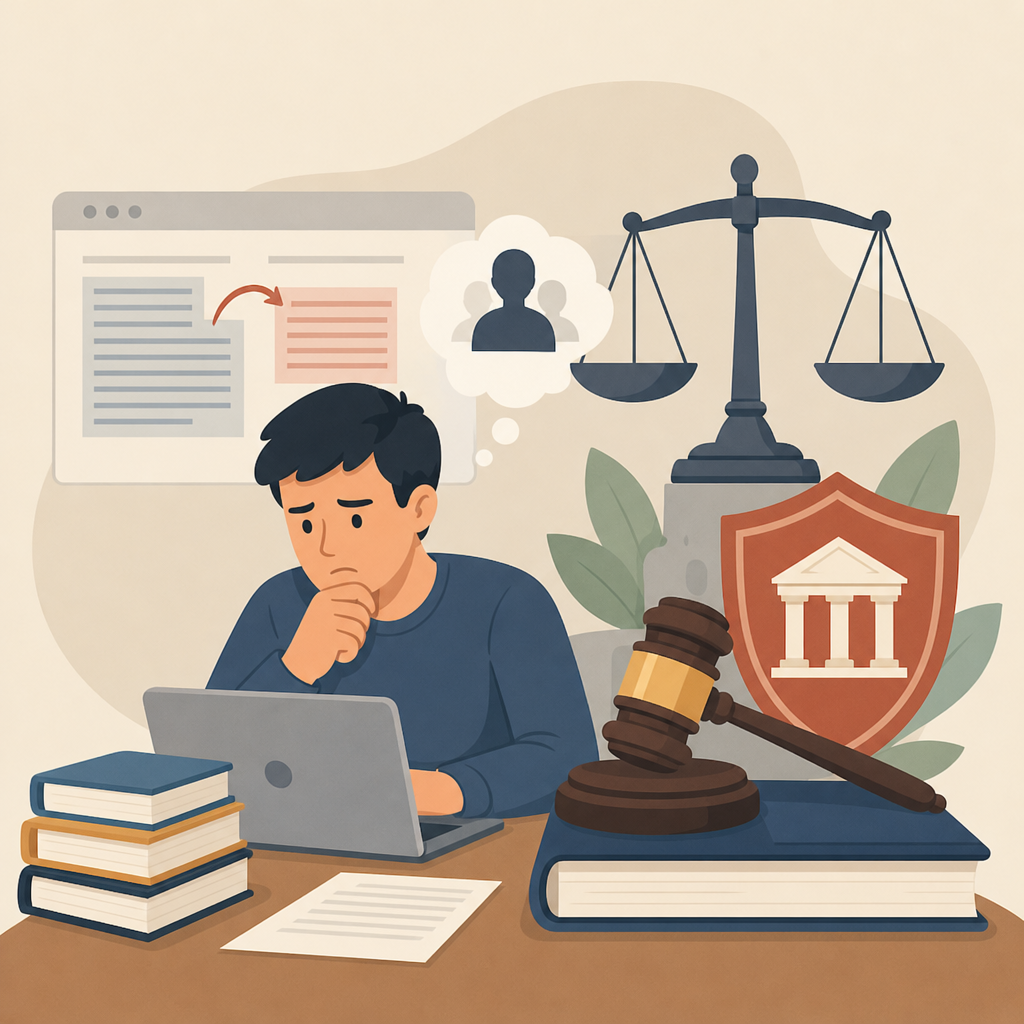
Plagiarism is the act of presenting another person’s words, ideas, structure, research, creative expression, or work as your own without proper credit.
In this guide
Understanding the Legal Implications of Plagiarism
Plagiarism is the act of presenting another person’s words, ideas, structure, research, creative expression, or work as your own without proper credit. Legally, plagiarism is not always the same thing as copyright infringement, but the two can overlap when copied material is protected by copyright and used without permission or a valid exception. This article explains the plagiarism definition, where plagiarism laws may come into play, and why plagiarism consequences can be academic, professional, financial, or legal.
What does plagiarism mean?
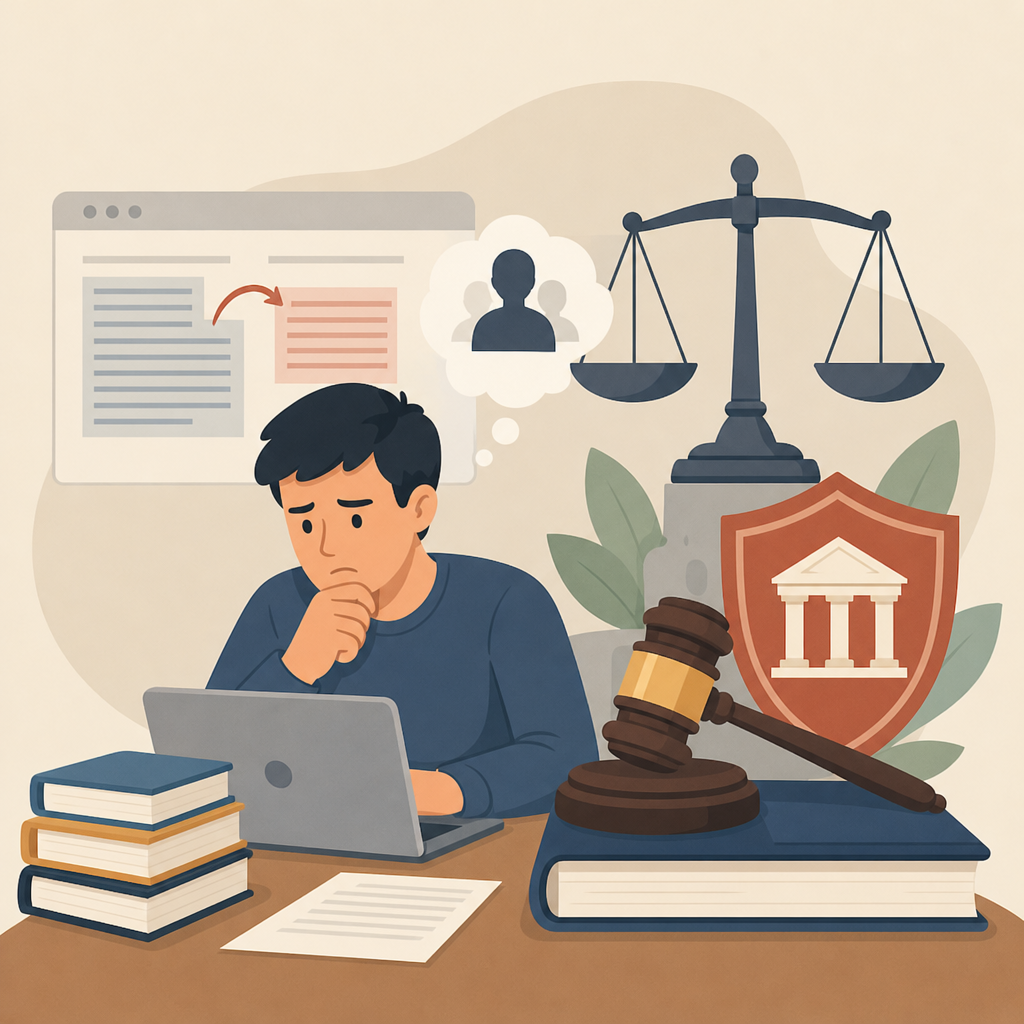
Plagiarism means using someone else’s work or intellectual contribution without clearly acknowledging the source. In academic and research settings, the Office of Research Integrity defines plagiarism as appropriating another person’s ideas, processes, results, or words without giving appropriate credit, while Purdue OWL describes it more broadly as using someone else’s ideas or words without proper credit. (ori.hhs.gov)
That definition matters because plagiarism is about attribution, not only copying. A person can plagiarize by pasting exact sentences without quotation marks, but also by closely paraphrasing a source, reusing another person’s argument, submitting purchased work, or presenting research findings as if they were original. In many schools and workplaces, plagiarism can be intentional or accidental, although intent often affects how serious the penalty becomes. (owl.purdue.edu)
A practical plagiarism definition includes several core elements:
- Borrowed material: words, ideas, data, images, code, charts, designs, processes, or creative structure from another source.
- Insufficient credit: missing citation, incomplete citation, misleading citation, absent quotation marks, or attribution that hides how much was borrowed.
- False impression of originality: the reader, instructor, employer, publisher, or client is led to believe the work is more original than it is.
- Context-specific standards: citation expectations vary across classrooms, journals, workplaces, creative industries, and legal settings.
- Potential consequences: plagiarism penalties may come from school policy, employment rules, publishing contracts, research regulations, or copyright law.
The key point is simple: plagiarism is an integrity problem first. It becomes a legal problem when the conduct also violates a law, contract, policy, or protected right.
Plagiarism and copyright infringement are related but different
Plagiarism and copyright infringement often appear together, but they are not identical. Plagiarism focuses on credit: did the person honestly identify the source? Copyright infringement focuses on legal rights: did the person use protected expression in a way the copyright owner can control, without permission or a valid defense? Copyright protects original works of authorship fixed in a tangible form, but it does not protect bare facts, ideas, systems, methods, or concepts. (copyright.gov)
That distinction creates situations where plagiarism may exist without copyright infringement. For example, copying an uncopyrightable fact without citation may be plagiarism in a school paper, but not copyright infringement. Using a public-domain passage without credit can also be plagiarism, even though copyright law may no longer restrict use of that passage.
The reverse can also happen: a person might give credit and still infringe copyright. Attribution is not the same as permission. If someone reposts a protected article, photo, song, illustration, or software code and says who created it, that credit may reduce ethical confusion, but it does not automatically make the use lawful. The U.S. Copyright Office notes that copyright owners can pursue legal action when a work is used unlawfully without permission and no exception or limitation, such as fair use, applies. (copyright.gov)
|
Issue |
Plagiarism |
Copyright infringement |
|---|---|---|
|
Main concern |
Honesty and attribution |
Unauthorized use of protected expression |
|
What it protects |
Credit for words, ideas, research, or work |
Legal rights in original expression |
|
Can facts be involved? |
Yes, if a source is not credited where required |
Facts themselves are generally not protected |
|
Is citation enough? |
Often necessary, though not always sufficient |
No, permission or a legal exception may still be needed |
|
Common forum |
Schools, publishers, employers, research bodies |
Courts, Copyright Claims Board, settlement demands |
Is plagiarism against the law?
Plagiarism itself is not always a crime or civil legal claim in the United States, and there is no single rule that makes every unattributed sentence automatically illegal. However, plagiarism can become legally significant when it involves copyright infringement, fraud, breach of contract, false authorship claims, professional misconduct, or research misconduct. This is why the better question is not only “is plagiarism against the law?” but “what rights, rules, or duties did the conduct violate?”
In academic settings, plagiarism is usually handled through academic integrity rules rather than court. A student may receive a failing grade, probation, suspension, expulsion, or required educational training, depending on institutional policy and the seriousness of the violation. Stanford’s student conduct materials, for example, describe possible academic penalties, education requirements, suspension, and expulsion as available sanctions in its conduct system. (communitystandards.stanford.edu)
In research settings, plagiarism can also fall under misconduct rules. The Office of Research Integrity includes plagiarism, along with fabrication and falsification, within its definition of research misconduct for covered research contexts. It also clarifies that research misconduct does not include honest error or differences of opinion, which is important because not every citation mistake is treated the same way. (ori.hhs.gov)
In professional settings, plagiarism consequences may come from employment agreements, client contracts, publishing terms, licensing rules, or professional codes. A marketing employee who copies a competitor’s website, a journalist who borrows paragraphs without credit, or a consultant who reuses a client’s proprietary report may face discipline even before any lawsuit is filed. If the copied material is copyrighted, confidential, or contractually restricted, the legal exposure can grow.
The legal implications depend on the type of material used
The law does not treat every copied item the same way. Copyright law draws a major line between protected expression and unprotected ideas, facts, procedures, methods, systems, concepts, principles, and discoveries. In practical terms, you generally cannot own the fact that a historical event occurred, but you may own the creative way you wrote about it. (copyright.gov)
That is why copying a statistic, a basic fact, or a general concept may raise attribution concerns without necessarily becoming copyright infringement. Still, academic integrity often requires citation even when copyright does not. A research paper that uses a scholar’s theory, a journalist’s original reporting, or a lab’s findings without credit can be plagiarism because the writer is claiming intellectual labor that belongs to someone else.
Protected expression is different. If you copy paragraphs from an article, a photograph from a website, code from a repository, an illustration from a book, or a video clip from a creator, copyright issues may arise. Whether the use is allowed depends on factors such as ownership, license terms, permission, public-domain status, and fair use.
Common categories include:
- Words and written content: blog posts, books, essays, reports, scripts, emails, articles, and website copy may be protected if original and fixed.
- Images and visual works: photos, charts, infographics, artwork, and diagrams can create both plagiarism and copyright concerns when reused without attribution or permission.
- Data and research results: raw facts may not be protected by copyright, but the collection, presentation, analysis, and required academic credit can still matter.
- Software and code: code may be governed by copyright, open-source licenses, employment agreements, or platform terms.
- Student and workplace materials: unpublished work can still raise plagiarism, confidentiality, policy, and ownership issues.
Fair use can apply, but it is not a shortcut around attribution
Fair use is a legal doctrine that may allow unlicensed use of copyrighted material in certain circumstances, including criticism, comment, news reporting, teaching, scholarship, or research. Courts evaluate fair use case by case, commonly looking at the purpose and character of the use, the nature of the copyrighted work, the amount used, and the effect on the market for the original. (copyright.gov)
Fair use is not the same as “I cited the source.” A properly cited excerpt can still exceed what fair use allows, especially if it copies the heart of a work, substitutes for the original, or harms the market for the original. Likewise, a use may be legally fair but still academically improper if it lacks citation.
This creates a common mistake: assuming that educational use is automatically legal. Teaching, scholarship, and research are important fair use contexts, but they do not guarantee an outcome. The Copyright Office emphasizes that fair use is fact-specific and that there is no fixed number of words, lines, pages, or percentage that always qualifies. (copyright.gov)
A safer approach is to separate the questions:
- Attribution question: Have I clearly credited the source according to the required style or policy?
- Permission question: Do I need permission, a license, or public-domain confirmation to use this material?
- Fair use question: If I am relying on fair use, can I explain why the use is limited, transformative, and unlikely to substitute for the original?
- Policy question: Does my school, employer, publisher, or client impose stricter rules than copyright law?
Plagiarism penalties can be academic, professional, and legal
Plagiarism penalties vary because plagiarism occurs in different environments. A first-year student who misformats citations, a graduate researcher who copies methods text, a freelancer who sells duplicated web copy, and a business that republishes a competitor’s guide may all face different processes and outcomes.
Academic penalties are often the most familiar. Purdue OWL notes that student consequences can include failing grades on assignments or classes, academic probation, and even expulsion, while also recognizing that accidental plagiarism may sometimes be treated as a learning opportunity. (owl.purdue.edu)
Professional consequences can be just as serious. Plagiarism may lead to reprimands, lost employment, damaged credibility, withdrawn articles, broken contracts, client disputes, or loss of future opportunities. In fields built on trust, such as journalism, research, education, consulting, law, healthcare, and publishing, the reputational harm may last longer than the immediate penalty.
Legal consequences arise when plagiarism overlaps with a legal claim. For copyright infringement, remedies may include injunctions, actual damages and profits, statutory damages where available, and in some cases enhanced statutory damages for willful infringement. Under U.S. copyright law, statutory damages for ordinary infringement may range from $750 to $30,000 per work, and courts may increase the amount for willful infringement up to $150,000 per work; courts may also reduce damages for innocent infringement in some circumstances. (copyright.gov)
Those numbers do not mean every plagiarism incident produces a lawsuit or maximum damages. Legal outcomes depend on facts such as registration, ownership, the amount copied, the market impact, available defenses, the parties involved, and whether the issue is resolved before litigation. For U.S. works, registration is generally required before bringing an infringement lawsuit in federal court, and registration can affect available remedies. (copyright.gov)
Common examples and misconceptions
Plagiarism often happens because people misunderstand what must be credited. Some assume that changing a few words is enough. Others believe online material is free to reuse, or that a citation cures every legal risk. These assumptions can create plagiarism consequences even when the writer did not intend to deceive.
Useful examples include:
- Copying exact text without quotation marks: Even with a citation, exact wording normally needs quotation marks or block formatting.
- Patchwriting: Closely following a source’s sentence structure while swapping in synonyms can still be plagiarism.
- Uncredited paraphrasing: Rewriting another person’s idea in your own words usually still requires citation.
- Self-plagiarism: Reusing your own prior paper, article, or client work without permission or disclosure may violate academic or professional rules.
- Image reuse: Crediting a photographer does not automatically grant permission to use the image.
- AI-assisted writing: If an AI tool produces text based on sources, the human user still needs to verify originality, citations, and rights.
- Group work confusion: Submitting shared work as individual work can violate academic integrity rules if collaboration was not allowed.
- Public-domain confusion: Public-domain material may be free of copyright restrictions, but ethical or academic citation may still be required.
A helpful rule is to cite when a reasonable reader would want to know where the words, idea, data, or evidence came from. Purdue OWL advises giving credit for words or ideas from many types of media, interview information, exact words or unique phrases, visual materials, and reused digital media. (owl.purdue.edu)
How to reduce plagiarism risk
Avoiding plagiarism is not only about avoiding punishment. It also makes writing stronger because readers can verify sources, distinguish your ideas from borrowed material, and trust the work. Good attribution shows where your thinking begins, how your evidence supports it, and what contribution you are making.
Use this checklist before submitting, publishing, or delivering work:
- Track sources from the start. Save author names, titles, URLs, publication details, page numbers, image credits, license terms, and access dates when relevant.
- Mark exact language immediately. If you copy text into notes, put it in quotation marks right away so it is not mistaken for your own draft later.
- Separate quote, paraphrase, and summary. Quotes use exact words, paraphrases restate specific ideas, and summaries condense larger points; all may need citation.
- Cite ideas, not just words. If a theory, argument, method, or interpretation came from someone else, credit the source even when your wording is original.
- Check license and permission rules. For images, videos, code, templates, and long excerpts, attribution may not be enough.
- Follow the required style. MLA, APA, Chicago, legal citation, journal rules, and workplace style guides handle sources differently.
- Disclose reuse. If you want to reuse your own prior work, ask whether permission or disclosure is required.
- Review institutional or contract policies. Academic integrity rules, employment agreements, and publishing contracts may be stricter than copyright law.
The practical meaning of plagiarism laws
The phrase “plagiarism laws” can be misleading because plagiarism is usually governed by a mix of rules rather than one universal statute. In the United States, copyright law addresses unauthorized use of protected expression; academic integrity policies address honesty in learning; research misconduct rules address credit in covered research contexts; and contracts or workplace policies may create additional duties.
For students, the main risk is often institutional discipline. For writers and businesses, the risk may include copyright claims, takedown demands, contract disputes, lost clients, or reputational harm. For researchers, plagiarism can threaten funding, publication, credibility, and compliance obligations.
The safest mindset is to treat attribution and permission as separate responsibilities. Credit the source so readers understand what is borrowed. Then ask whether the use is legally allowed, contractually allowed, and appropriate under the rules of the setting.
Plagiarism is not just a technical citation error; it is a misrepresentation of authorship. When protected expression is copied, it can also become copyright infringement. Understanding both sides helps you write, study, publish, and work with more confidence—and with far less legal and ethical risk.