Exploring Duey AI: The Human Touch
AI writing is no longer just about producing words quickly. The real challenge is making those words feel intentional, specific, and believable to the person

In this guide
Exploring Duey AI: The Human Touch
AI writing is no longer just about producing words quickly. The real challenge is making those words feel intentional, specific, and believable to the person reading them. Duey AI sits in that conversation as a writing-tool suite with a Humanizer, Auto Typer, Sessions, and AI Detector, all aimed at helping digital text feel more like a real writing process rather than a pasted block of machine-made copy. (duey.ai)
For writers, students, marketers, and teams, the bigger topic is not simply “Can AI write this?” It is “Can this sound like it came from someone who understands the audience?” That is where the duey ai humanizer and the broader idea of humanizing AI become interesting.
What does it mean to make AI writing sound human?
Making AI writing sound human means shaping a draft so it has context, rhythm, judgment, and a clear point of view. It is not just swapping words or adding casual phrases; it is improving the way the message lands with a real reader. A strong AI humanizer should help reduce the stiff, overly polished, or generic patterns that often appear in AI-generated text while preserving the core meaning.
Human writing usually contains small signs of decision-making. It prioritizes some ideas over others. It explains why something matters. It uses examples that fit the situation rather than broad statements that could apply anywhere. When people talk about humanizing AI, they are usually asking for text that feels less automated and more aware of the reader’s needs.
This matters because modern AI communication is everywhere: emails, essays, landing pages, support replies, internal notes, social posts, and long-form content. If every message sounds the same, readers notice. They may not know exactly why the copy feels flat, but they can often sense when it lacks ownership.
The role of Duey AI in the writing workflow
Duey AI is not described as only one tool. Its help content presents it as a set of writing tools for Google Docs, Google Slides, and Word Online, including Sessions, Auto Typer, a Humanizer, and an AI Detector. The Humanizer is specifically described as rewriting AI-generated text so it reads as human-written. (duey.ai)
That positioning makes Duey AI relevant to a practical workflow: draft, revise, place the writing where it needs to go, and review how it may be perceived. The duey ai humanizer is one part of that process, not a replacement for thinking. Used well, it can help smooth rough AI output, but the best results still come from a writer who checks tone, accuracy, structure, and intent.
A typical workflow might look like this:
- Start with a clear draft. Use AI to create a base, but provide enough context so the draft has direction.
- Review for meaning. Before making the text sound more natural, confirm that the facts, claims, and logic are right.
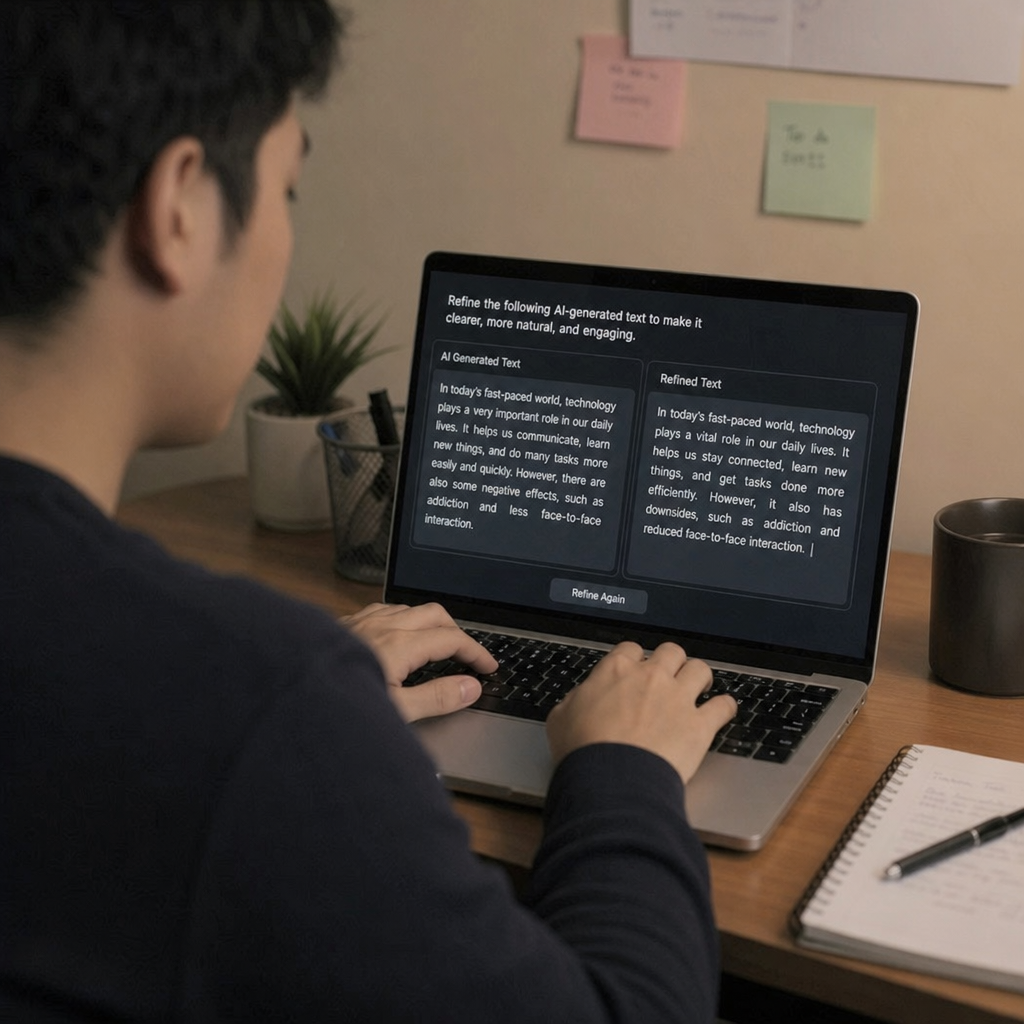
- Run a humanizing pass. Use an AI humanizer to reduce robotic phrasing, repetitive sentence patterns, or unnatural transitions.
- Add personal judgment. Insert examples, details, caveats, and phrasing that match the real speaker or brand.
- Read it aloud. If it sounds like something no person would comfortably say, keep editing.
The key is to treat Duey AI as support for better communication, not as a shortcut around responsibility. Human-sounding text still needs human accountability.
Why AI personalization changes the way people read
AI personalization is one of the main reasons humanized writing matters. A generic draft may be technically correct, but it often misses the emotional and situational cues that make content useful. Personalized writing considers who is reading, what they already know, what they are worried about, and what action they may take next.
For example, a small business owner reading about AI tools may want practical time savings, not abstract theory. A student may need clarity and confidence, not jargon. A content manager may care about brand consistency, editing speed, and whether a draft sounds too similar to hundreds of other AI-assisted articles. The words may cover the same topic, but the message should shift depending on the reader.
That is where AI interaction becomes more nuanced. The user is not only asking a tool to “make this better.” They are guiding the tool toward a specific audience, situation, and tone. Better input usually creates better output, and better revision turns that output into something worth publishing or sharing.
How can writers use the Duey AI Humanizer responsibly?
Writers can use the Duey AI Humanizer responsibly by treating it as an editing assistant rather than a disguise. The goal should be clearer, more natural communication, not hiding careless work, false claims, or unauthorized AI use. Duey markets a free humanizer that rewrites AI text, and its site says users can paste text and humanize it without an account, but the final responsibility for the message still belongs to the person using the tool. (duey.ai)
Responsible use starts with honesty about the context. A marketing team using AI to speed up first drafts has different obligations than a student working under a course policy or a professional preparing regulated content. If rules apply, follow them. If the content carries risk, verify it. If the draft represents your judgment, make sure it truly reflects what you mean.
A practical checklist helps keep humanizing AI useful and ethical:
- Check the original meaning. Make sure the revised version does not distort the point.
- Remove unsupported claims. A smoother sentence is still a problem if it says something unproven.
- Match the real voice. Add the vocabulary, tone, and level of detail that the actual author or brand would use.
- Preserve necessary precision. Do not trade accuracy for casualness.
- Respect disclosure rules. If a school, workplace, client, or publication has AI-use guidelines, follow them.
- Edit beyond surface style. Human communication is also structure, empathy, examples, and judgment.
AI tools can make text more readable, but they cannot decide what is appropriate in every situation. That is the human part.
Human-sounding text depends on more than word choice
Many people assume an AI humanizer works by replacing formal words with casual ones. That can help in some cases, but it is not enough. A sentence can use simple language and still feel mechanical if it lacks purpose.
Human-sounding writing often has a few deeper qualities:
- Variation: Sentence length and structure change naturally.
- Specificity: The writer names the real problem instead of circling around it.
- Context: The content explains why the point matters now or to this reader.
- Restraint: Not every sentence oversells, overexplains, or repeats the same benefit.
- A point of view: The writing makes choices instead of listing neutral information endlessly.
This is especially important in AI communication for brands. A company that sounds warm in one paragraph and stiff in the next may feel inconsistent. A support reply that is technically polite but ignores the customer’s frustration may feel hollow. A blog post that includes keywords but no useful insight may rank poorly with humans, even if it appears optimized on the surface.
The best use of duey ai is therefore not simply “make this undetectable” or “make this casual.” It is “help this draft sound more like something a thoughtful person would send.” That difference matters.
What should you look for after using an AI humanizer?
After using an AI humanizer, look for clarity, accuracy, tone, and reader fit. Do not judge the result only by whether it sounds less robotic. A good revision should communicate the same idea more naturally while making the next step easier for the reader to understand.
Start by comparing the before and after versions. Did the revised copy keep the important details? Did it accidentally soften a strong point or exaggerate a simple one? Did it create awkward phrasing while trying to sound more natural? Humanized text should feel cleaner, not noisier.
Use this quick review framework:
|
Review area |
What to check |
Why it matters |
|---|---|---|
|
Meaning |
The revised text says the same thing as the original |
Prevents accidental distortion |
|
Voice |
The tone matches the author, brand, or assignment |
Keeps communication consistent |
|
Flow |
Ideas move in a logical order |
Helps readers follow the message |
|
Specificity |
Examples and details feel relevant |
Reduces generic AI texture |
|
Accuracy |
Facts, claims, and names are verified |
Protects credibility |
|
Purpose |
The reader knows what to think or do next |
Turns text into communication |
This kind of review is also useful because AI detectors are not perfect arbiters of authorship. OpenAI has noted limitations around AI-generated content detection, and university guidance commonly warns against treating detector scores as conclusive evidence because of reliability concerns and false positives. (help.openai.com)
That does not mean detection concerns are irrelevant. It means polished communication should not depend on a score alone. Strong writing comes from a clear process: draft, revise, verify, personalize, and take ownership.
Where Duey AI fits in a human-centered content process
Duey AI fits best when the writer already knows the goal. If you have a rough draft that sounds stiff, the Humanizer can help reshape it. If you need a document workflow, Duey’s broader suite may support how text appears in tools like Google Docs, Slides, or Word Online. If you want to review how text might be perceived, an AI Detector can be one signal, though not the whole truth. (duey.ai)
The more strategic question is how much human input you add before and after the tool runs. A thin prompt followed by a humanizer pass will often produce average content. A thoughtful draft with real context, careful editing, and a final human review can become much stronger.
For content creators, this means using AI personalization deliberately. Tell the tool who the audience is. Clarify whether the piece should sound professional, conversational, persuasive, cautious, or instructional. Add examples from your actual product, service, class, or project when appropriate. Then revise until the final piece sounds like it belongs in your world.
For teams, it may help to create a simple internal standard:
- What AI tools are allowed?
- When should AI use be disclosed?
- Who verifies factual claims?
- What brand voice rules must every draft follow?
- Which content types require extra review?
These questions turn AI interaction into a repeatable process rather than a guessing game.
The real human touch is judgment
The growing interest in the duey ai humanizer reflects a larger shift in writing. People are not rejecting AI assistance; they are rejecting content that feels careless, generic, or disconnected from real intent. Humanizing AI is valuable when it improves clarity, tone, and usefulness.
Duey AI can support that process by helping AI-generated text read more naturally and by fitting into common document workflows. But the human touch does not come from a button alone. It comes from knowing the audience, checking the facts, choosing the right emphasis, and being willing to edit until the message feels honest.
In the end, the best AI communication is not the text that hides its origins most effectively. It is the text that respects the reader’s time, sounds like it was shaped with care, and says something worth saying.